

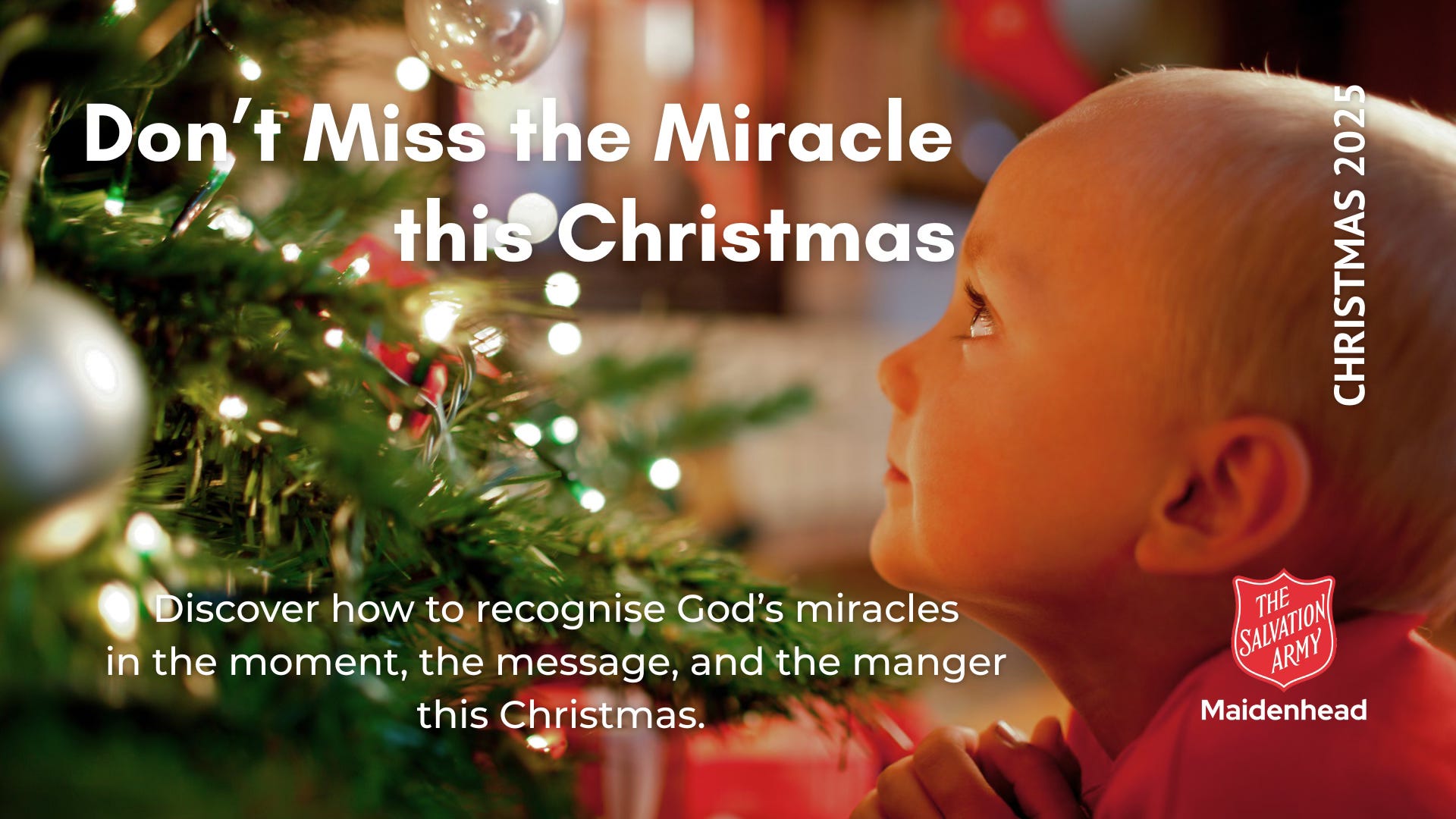
This seven-day Christmas series invites us to slow down, look again at the Christmas story, and notice the miracle of God’s work in our world and in our lives.
Across the first three days (22–24 December), we explore the Miracle of the Method from Romans 11.
We discover:
God’s ways are far above ours – even when life makes no sense, his wisdom is perfect (22 December).
God uses ordinary people – he chooses shepherds, carpenters, and people like us to carry his hope (23 December).
God is working for our good – he weaves a beautiful tapestry through every joy and struggle (Christmas Eve).
Then, from Christmas Day onwards, we reflect on the Miracle of the Manger from John 1.
These four days invite us to decide what we believe about Jesus and how we will follow him:
God came close – the Word became flesh and made his home among us (Christmas Day).
We must choose what we believe – Jesus leaves no room for neutrality; to believe is to become a child of God (Boxing Day).
Jesus brings light into our darkness – his life and light guide us into the year ahead (27 December).
Jesus claims our whole lives – if he is truly Lord, then he calls us to follow him in every place we live, work, and serve (28 December).
Together, these seven days form a gentle yet powerful journey from wonder, to trust, to decision, to discipleship.
They reveal a God who is wiser than we can imagine, closer than we dare hope, and more committed to our good than we will ever fully grasp.
Here are the Battle Drill Daily Devotionals for the coming week. The accompanying video and audio podcast episodes will be published each day.
Thanks for reading Battle Drill Devotional! Subscribe for free to receive new posts and support my work.
The 4-Minute Prayer for Total Confusion
Monday 22 December 2025
Do you ever feel completely lost, especially when the Christmas holiday season kicks into high gear? As Christmas gets closer, the pressure can really build. The lights are twinkling and the carols are playing, but inside, you might just be wrestling with a whole lot of confusion. It’s a time when so many of us start questioning God’s plan, wondering why things just don’t seem to be making any sense. Today, we’re going to talk through a powerful prayer that can help you find real peace, right in the middle of all that chaos.
Life can feel like a whirlwind, can’t it? The expectations, the family gatherings, the pressure to find the perfect gift - it can all get to be too much. You might be feeling the weight of questions that have no answers, the heavy burden of stress, or just the ache of loneliness. It’s so easy to feel like you’re wandering in a thick fog, totally unable to see the path in front of you.
In moments like these, you have to remember you’re not alone in this. So many people feel this way when life takes an unexpected turn. The Apostle Paul wrote something profound in the book of Romans about God’s wisdom. In Romans 11:33, he says, Oh, how great are God’s riches and wisdom and knowledge! How impossible it is for us to understand his decisions and his ways! This is such a great reminder that God’s plans are often bigger than we can possibly understand.
So, what do we do when we can’t see the way forward? The answer is actually pretty simple: we pray. Today, I want to share a 4-minute prayer that can help you find clarity and rest, even when you can’t see what God is doing. This isn’t about just saying some words. It’s about having a real, heartfelt conversation with God and inviting his peace into your wonderfully chaotic life.
As we get ready to pray, just think about what this moment means. Prayer is this incredible tool that connects us directly to God’s wisdom and his love. It’s a chance to be honest about our confusion, our fears, and our hopes. When we pray, we open ourselves up to his presence, allowing him to be our guide through the storm.
Now, let’s take a moment to pray together. I invite you to get comfortable, close your eyes if you’d like, and join me in this prayer:
Heavenly Father, in this moment of confusion and chaos, I just come before you with an open heart. I admit I don’t always understand your ways. Life feels overwhelming, and I feel lost. But I choose to trust that your wisdom is so much greater than my own understanding.
Help me find peace right in the middle of this uncertainty. Remind me that your plans are for my good, even when I can’t see them. I give my worries and my fears to you, knowing that you hold my future in your hands.
Lord, please give me the strength to trust you, even when it feels like I’m wandering in the dark. Help me to remember the beauty of this Christmas season - a time when you came into our world in the most unexpected way. Just like you surprised the shepherds with the news of Jesus’ birth, I trust that you can bring a surprising light into my confusion.
Thank you for your unending love and grace. I choose to rest in your presence, knowing that you are with me, every single step of the way. In Jesus’ name, I pray, Amen.
As we finish our prayer, I want to encourage you to just sit for a second and think about what you’ve shared with God. How does it feel to let go of that confusion and simply trust in his wisdom? Remember, it is perfectly OK to not have all the answers. God actually invites us to bring our questions and our uncertainties straight to him.
In the days ahead, as you go through the rest of the Christmas holiday season, I challenge you to come back to this prayer anytime you start to feel overwhelmed. Let it be a source of comfort and strength for you.
Even when we can’t understand the “why,” we can trust that God’s love and wisdom are always there, guiding us through the chaos. May you find true peace and clarity this Christmas, trusting that even in your confusion, God is at work.
Why God Gave the Biggest News to Complete Nobodies
Tuesday 23 December 2025
What if the most important news in history wasn’t sent to a king in a palace or a priest in a temple? What if it wasn’t a front-page headline? What if the single most significant announcement ever was given to a small group of guys considered so untrustworthy, they weren’t even allowed to testify in court? This is the story of the first Christmas, but it’s really about why the announcement of all time bypassed the powerful and went to a crew of outcasts working the night shift.
Every year, we retell the Christmas story. We know the main characters: Mary, Joseph, the baby Jesus. But there’s a group that’s always huddled off to the side that we rarely give a second thought: the shepherds. We often treat them like extras in their own story. But what if they aren’t extras at all? What if their presence is one of the most radical and profound parts of the whole narrative? The choice to announce the Messiah’s birth to shepherds wasn’t an accident. To understand why God gave the biggest news to these nobodies, we first have to understand just how “nobody” they really were.
Today, we have a romanticised view of shepherds, but in first-century Judea, they were at the very bottom of the social ladder. Their job made them ritually unclean according to the religious laws of the day. Their work with animals and death kept them from participating in temple worship, cutting them off from the religious life of their community. Their reputation was even worse. Shepherds were widely seen as dishonest, and it was assumed you couldn’t buy wool or milk from them because it was probably stolen. This stereotype was so strong that a shepherd’s testimony wasn’t allowed in a court of law. In the eyes of the establishment, they were officially labelled “sinners” - a group of men stripped of basic rights and branded as liars. They were invisible and forgotten. And it’s to these men that heaven decides to break its silence.
The Gospel of Luke sets the scene. It’s night. The shepherds are doing what they do every night: guarding their flocks. It’s a mundane, thankless job. Suddenly, that darkness is shattered. An angel of the Lord appears, and the radiance of the Lord’s glory surrounded them. This was a terrifying, brilliant light, and their reaction was exactly what ours would be: they were terrified. But the angel’s first words are, “Don’t be afraid!” … “I bring you good news that will bring great joy to all people. The Savior—yes, the Messiah, the Lord—has been born today in Bethlehem, the city of David! Let’s not miss how radical this is. It’s good news for all people, and the very first people to hear this universal message are the ones society had completely excluded. And then, the sky suddenly fills with an entire army of angels, praising God. For a few stunning moments, this lonely field becomes the stage for a cosmic worship service, with an audience of outcast shepherds.
So, why shepherds? Why skip the centres of power and go straight to the fringes? First, choosing shepherds was a powerful declaration of inclusion. By giving the announcement to the lowest members of society, God was making it clear that this message was for everyone, from the bottom up. It was a direct challenge to the social and religious rankings of the day, declaring that God’s kingdom plays by different rules, where the last are first.
Second, the very idea of a shepherd is packed with meaning. God himself is often called the shepherd of his people. Leaders, like King David - a shepherd himself - were meant to be shepherds to the nation. But prophets also called out corrupt leaders as “bad shepherds”. So, there’s a beautiful poetry in literal shepherds being the first to meet the one called the Good Shepherd. Some scholars even suggest these men were raising lambs for the temple sacrifices. Now, the shepherds who watched over the temporary sacrifice were the first to witness the arrival of the final “Lamb of God”.
The story of the shepherds is a profound statement about the very heart of God. It shows us that God intentionally seeks out the overlooked and marginalised to be key players in his grand story. This is a pattern you see all through the Bible. God chose Abraham, an old man. He chose Joseph, a prisoner. He chose David, a shepherd boy. And he chose Mary, a young, unknown girl from a small town, to be the mother of the Messiah.
The message to the shepherds is for every one of us who has ever felt ordinary, overlooked, or insignificant. It’s a reminder that God doesn’t see our social status or our influence. He sees the heart. The birth of Jesus was living proof that this new Kingdom was being built not on human power, but on humility and radical inclusion. So, this Christmas, when you see a nativity scene, take a closer look at those guys on the edge of the action. They aren’t just props. They are the heroes of a story that proves the most extraordinary news often comes to the most ordinary people. And that is good news for us all.
This Christmas Your Mess Becomes Your Miracle
Christmas Eve
As we head into Christmas, with all its pressure to be joyful and perfect, does your life feel more like a tangled mess than a celebration? If so, you’re not alone. But what if this Christmas, that very mess is the raw material for your miracle?
The end of the year feels like a final exam, doesn’t it? We look back, hoping to see a neat line of successes, but a lot of us just see a jumble. We see the frayed edges of relationships that broke down, the knots of confusion from prayers that seem unanswered, and the tangled threads of plans that just completely fell apart. It feels like a mess. Then Christmas arrives, shining a bright light on everything, demanding joy, and celebration, which can honestly make the shadows of our own messes feel even darker.
It’s so easy to look at our lives from this angle - from underneath the mess - and only see chaos. From our perspective, it’s just a random pile of tangled, knotted threads. There’s no clear pattern or picture. We see the sorrow, the struggle, the loose ends, and we start to wonder, what is God even doing? Does He see this? Was this whole year just a loss? It’s a lonely feeling, being surrounded by carols of peace and joy when all you can feel is the tension in your own story.
But here’s a truth that can change everything. What if I told you that God isn’t looking at the underside of the fabric? He’s the Master Weaver, and from his perspective, he sees a magnificent tapestry he’s creating with your life. He sees the full design, crafted with incredible skill and purpose.
The Bible gives us a promise that anchors this very idea. It’s in Romans 8:28, and it says this: And we know that God causes everything to work together for the good of those who love God and are called according to his purpose for them. Now, this verse isn’t a promise of an easy, pain-free life. It doesn’t say that all things are good. It says God works in all things for our good. The “good” he is working towards is our transformation into the people he created us to be. He doesn’t waste our pain. He rewrites it. Every single thread, no matter the colour - dark or light, joyful or sorrowful - has a purpose in his hands.
We don’t have to look any further than the very first Christmas to see this in action. The Christmas story, the one we picture with beautiful, serene nativity scenes, was actually incredibly messy. It was a story of a miracle showing up right in the middle of a mess. Think about Mary. A young, engaged girl who suddenly finds out she’s pregnant, and not by her fiancé. Her entire life was turned completely upside down. She was facing confusion, public shame, and overwhelming fear. It was a mess.
And what about Joseph? A good, righteous man who discovers his betrothed is pregnant, and he knows the child isn’t his. His plans, his future, his reputation - it was all thrown into chaos. He was ready to end the relationship quietly just to spare her shame. His life was a mess, too. From their perspective, from the underside of the tapestry, it must have looked like an absolute disaster.
But they both chose obedience right in the middle of their uncertainty. Mary said, I am the Lord’s servant. May everything you have said about me come true. Joseph, after his own visit from an angel, chose to trust God and take Mary as his wife. And through their messy, complicated, and frightening situation, God wove the greatest miracle in history: the birth of Jesus, our Immanuel, which means “God with us”. Their story proves that God doesn’t just work despite the mess. He works through it.
God is still in the business of weaving miracles out of messes. That struggle you’ve faced this year, that disappointment that still stings, that question you’re almost afraid to ask - it’s not a discarded thread. It is the very material God is using to shape something beautiful in your life. He’s inviting you to trust the Weaver’s hands, even when you can’t see the final picture.
Let’s end with a prayer.
Lord, thank you that you are the Master Weaver. We confess that we so often only see the knots and the tangled threads on the underside of our lives, and we lose hope. Help us to trust the work you are doing, even when we can’t see the full picture. This Christmas, help us to believe that the messes we’re in are the very places where your miracles are being born. Keep shaping us in your love. Amen.
Why The Creator of Everything Slept in A Manger
Christmas Day
We’ve all seen the nativity scenes. The peaceful baby Jesus, the adoring parents, and a few gentle-looking animals. It’s a serene image we put on our mantlepieces. But what if the reality of that night was far more shocking? What if the story we’ve tidied up is actually a radical, even a scandalous, account of a king choosing the absolute lowest place to begin his life?
The God who spun stars into existence, the Word who spoke galaxies into being, chose to enter our world not in a palace, but in total obscurity. He became a helpless baby in an animal’s food trough. Have you ever really let the shock of that sink in? The answer reveals the most profound and revolutionary love story ever told.
Let’s revisit that night in Bethlehem, but this time, beyond the plastic figurines. Let’s imagine the reality. It probably wasn’t a silent, holy night. The setting wasn’t a cozy wooden stable. Some of the earliest Christian traditions, dating back to the second century, say Jesus was born in a cave used to shelter animals. Imagine it - damp, thick with the smell of manure, and filled with the sounds of livestock.
Mary, exhausted from a long journey, gives birth far from home, without comfort or a proper bed. When the Creator of the universe takes his first breath, his first bed isn’t a royal cradle, but a manger - a rough, splintery feeding trough. The contrast is staggering. A king’s birth should be an event of power and pronouncements. Most scholars today see the nativity stories as theological narratives rather than strict historical accounts, but the theological point is what’s powerful. This wasn’t an accident. This wasn’t a flaw in the plan. This was the plan. And understanding why changes everything.
So, why the manger? The first and most powerful reason is captured in a single name: Immanuel, which means “God with us”. The God of the universe refused to be a distant, untouchable deity. The book of John says, So the Word became human and made his home among us. God didn’t shout his love from heaven. He whispered it by becoming small and one of us.
The manger is the starting point of this divine closeness. It’s a bold declaration that God isn’t afraid of our reality. He doesn’t just tolerate our world from a distance. He enters it, willingly and lovingly, to be right there with us.
That leads to the second reason: God became a baby to fully identify with our humanity. He didn’t arrive as a full-grown man with all the answers. He chose to experience the entire spectrum of human life - dependence, fragility, and struggle. He literally entered into our weakness.
The Bible says we have a high priest – Jesus - who understands our weaknesses because he faced all of the same testings we do, yet he did not sin (Hebrews 4:15). That life of deep, personal understanding began in the manger. He knows what it’s like to be helpless, to be overlooked, and to be uncomfortable. His compassion isn’t theoretical. It’s rooted in lived experience. The manger tells us that no matter how low we feel, God has been lower. He gets it.
Third, the manger was a profound statement about the kind of kingdom he came to build. In a world that worships power and status, God turned everything upside down. The manger was a deliberate rejection of the world’s values. It was a symbol that his kingdom isn’t built on force, but on love. It isn’t built on status, but on service. This was the birth of a new kind of power, one found in humility.
But there’s an even deeper layer of meaning. The birth happened in a town called Bethlehem, which in Hebrew means “house of bread.” And where was the baby laid? In a manger - a feeding trough. The symbolism is breathtaking. Jesus, who would one day call himself the “Bread of Life”, began his earthly life as a loaf of bread offered to a hungry world. It was a sign that he is our spiritual food, the only one who can satisfy our deepest hunger.
The distance between the throne of the cosmos and a feeding trough in Bethlehem is the measure of God’s love for you. The manger wasn’t an unfortunate circumstance. It was a deliberate, radical act of love. It was God emptying himself, becoming vulnerable and accessible to all. The shepherds, often seen as humble members of society, weren’t barred by palace gates. They were invited to the very first cradle-side.
That manger is an open invitation. It tells us that no one is too broken or too insignificant to come to God, because God has already come to us in our mess. He chose the lowest place to lift us all up.
So, this Christmas when you see a nativity scene, look past the quaint figurines. See the shocking humility. See the radical love. And see the King who chose to sleep in a manger, so that we could find a home in his heart.
The Decision We Cannot Avoid This Christmas
Boxing Day
The carols have faded, the family’s gone home, and the wrapping paper is cleaned up. In the quiet of 26 December, after all the chaos, the man at the centre of Christmas becomes a question we pack away for another year. But what if this year, on the day after Christmas, we finally faced the one decision we cannot avoid?
For many of us, the Christmas story is a comfortable tradition. We admire Jesus and respect his moral teachings. But then comes the day after Christmas. Historically, Boxing Day was for giving to the less fortunate - a day of charity after the celebration. It offers a natural pause to ask a deeper question. Because the Jesus we read about in historical accounts didn’t just offer helpful advice. He made claims so absolute they demand a response and admiring him from a distance isn’t one of the options he gives.
It’s easy to call Jesus a “good moral teacher”. It feels safe and non-committal. But here’s the problem: good teachers don’t say the kinds of things Jesus said. He didn’t just say, “be kind to one another”. The Gospels record him saying, I am the way, the truth, and the life. No one can come to the Father except through me. (John 14:6). He claimed he could forgive sins - which, in his culture, was something only God could do. He declared, The Father and I are one. (John 10:30).
These aren’t the statements of a simple philosopher. They’re claims of divinity. And once someone makes that claim, you can’t just call them a “good teacher”. You’re forced into a decision we often pack away with the Christmas ornaments. But the question remains.
This is where the writer and former sceptic C.S. Lewis comes in. He framed this problem with a powerful argument known as the “Liar, Lunatic, or Lord” trilemma. Lewis argued that when you look at what the Gospels record Jesus saying, you’re left with only three real possibilities.
First, he was a Liar. He knew he wasn’t God but scammed everyone for fame or power. But if that’s true, he’s not a great moral teacher. He’s a hypocritical con artist.
Second, he was a Lunatic. A man who sincerely, but tragically, believed he was God. But when you read the Gospels, you find someone with incredible wisdom, compassion, and poise, even while facing death. That doesn’t sound like insanity.
So, if he’s not a Liar and not a Lunatic, you’re left with one option: He is Lord. He is who he claimed to be: the Son of God. Lewis’s point is that calling Jesus just a “great human teacher” is the one option that isn’t logically on the table.
Choosing “Lord” isn’t just about winning a logical argument. It’s the beginning of everything else. It takes the story of Jesus from a yearly tradition to a living reality that can change you. When you accept that Jesus is who he says he is, you don’t just get a new set of rules. You get a new set of promises.
First, the promise of real forgiveness - wiping the slate completely clean. Second, the promise of restoration. He doesn’t just forgive your past. He starts to heal the broken parts of your present. And finally, the promise of hope. Not wishful thinking, but a concrete confidence that your life has ultimate meaning and that death isn’t the end.
All the joy of Christmas points to this one decision. It’s not one you should rush, but it’s also not one you can put off forever. So maybe this Boxing Day, in the quiet after the storm, is the perfect time to unbox this question for yourself - to move past just admiring Jesus and genuinely ask if you’re ready to trust him. If the logic is pointing you in one direction, maybe it’s time to see where it leads.
If this is a decision you’re wrestling with, you’re not alone. I encourage you to subscribe and check out other videos on this channel where we tackle these big questions.
The Christmas season is over, but its central figure remains. He isn’t silently waiting in a manger for next year. He’s actively asking you and me: “Who do you say that I am”? A liar? A lunatic? Or the Lord who offers forgiveness, restoration, and hope? That’s the decision we can’t avoid. And it’s the one decision that could change everything that comes next.
A Christmas Devotional for Every Step Ahead
Saturday 27 December 2025
As the year winds down, does the path ahead feel a little shadowy? Are you holding more questions than answers? Standing on the edge of a new year, it’s normal to feel a mix of excitement and worry. We make plans, but if we’re being honest, most of what’s coming is a mystery. It can feel like we’re fumbling in a dark room, hoping not to trip up.
This really got me thinking about the Christmas story. Beneath the cozy manger scene is a deep, ancient promise. It’s a promise not just for a single silent night, but for every uncertain step we’ll ever take.
The Bible is brutally honest about darkness. It’s more than just the sun going down. Darkness is the confusion we feel with no idea which way to turn. It’s the anxiety that can creep into our hearts and the feeling of being lost.
And when one year is ending and another is beginning, that feeling can get stronger. This past year might have brought disappointments that cast long shadows. The future can look like a huge, unlit map. We all want a roadmap, a five-year plan that’s guaranteed to work, but life rarely gives us that. That’s the darkness of the unknown.
But what if we were never meant to have a detailed map? What if, instead, we were offered a light?
When the apostle John opens his Gospel, he doesn’t start with a stable. He starts with a declaration: The Word gave life to everything that was created, and his life brought light to everyone. The light shines in the darkness, and the darkness can never extinguish it. (John 1:4-5).
John says that in Jesus, there is life, and that life is our light. This isn’t just pretty poetry. It’s the heart of the Christmas message. The very life of God, in the person of Jesus, stepped into our world to be a brilliant, guiding light - a light of truth, peace, and unshakable hope.
And don’t miss that last, powerful phrase: the darkness can never extinguish it. The original Greek word here can mean to conquer, to master, or to extinguish. Imagine the deepest, most absolute darkness. Now, picture a single, steady flame. The darkness can’t smother it. It can’t swallow it up. The smallest light changes the dark. That is the promise of Jesus. He is the light that our own personal darkness - our fear, our doubt, our confusion - simply cannot defeat.
His light doesn’t just show us the way. His light is the way.
So, how does this ancient promise actually help us as we look at the year ahead?
It means our hope for the future doesn’t depend on us seeing everything clearly. Our hope is in the One who is holding everything together. Walking in the light isn’t about being handed a giant floodlight that reveals the entire year. More often, it’s like holding a small lantern on a dark path. It doesn’t show you the final destination, miles away. It just shows you where to put your foot for the very next step. And then the next one.
Relying on this light is a daily choice. It’s choosing to trust that the light is enough for the single step you have to take right now. It’s about shifting our focus from worrying about the future to living with a joyful expectation of what God will do next.
This can be as simple as starting your day with a quiet, honest prayer. Before the world gets loud, you can just say: “Jesus, would you shine your light on my path today? Lead me in your truth and peace”. It’s a simple invitation for his presence to light up the ground right in front of you.
This Christmas, while we celebrate the Light of the World, let’s remember he isn’t just a historical figure. He is a present, living hope. He is the light for every single step ahead.
If this message encouraged you, maybe think about sharing it with someone who’s facing their own bit of uncertainty. I’d also love to hear from you in the comments - what’s one area of your life where you need God’s light to shine today? And if you’d like to get more devotionals like this one, subscribing is the best way to make sure we stay connected.
As we step into the new year, we don’t carry a guaranteed plan, but we do carry a promise. We don’t have all the answers, but we have a constant Companion. You don’t need to see the whole journey. You just need to see him, the Light of the world. And he is more than enough for the step you’re on and for every step still to come.
Let’s pray. Father, thank you for the gift of your Son, the light that no darkness can ever overcome. For every person listening who feels lost or uncertain about the future, I pray that you would shine your light brightly on the path right in front of them. Remind us that because you are with us, we have everything we need. Give us the courage to take the next step in faith. Amen.
Jesus Wants More Than Your Sunday Morning
Sunday 28 December 2025
You go to church every Sunday. You pray. Maybe you even lead a ministry or a growth group. You’re doing all the “right” things. But have you ever felt like there’s a gap between your Sunday faith and your Monday morning reality?
What if I told you that Jesus is less interested in your one hour of worship than he is in your forty hours of work, the way you talk to your family, and the thoughts you have about your bank account?
So many of us live a divided life. We have our “church life”, and then we have everything else. But the Bible tells a totally different story. It presents a faith that bleeds into everything - one that claims every single moment. In other words, whole-life discipleship.
So, why does this disconnect happen? Often, it comes down to a simple misunderstanding of who Jesus really is. The Apostle John opens his gospel with one of the most powerful statements ever written: In the beginning the Word already existed. The Word was with God, and the Word was God. He existed in the beginning with God. (John 1:1-2)
This isn’t just some pretty, poetic language. John is making a massive theological claim: Jesus isn’t just a great moral teacher or a historical figure. He is the eternal, divine Creator of everything. God created everything through him, and nothing was created except through him. Your job, your relationships, your resources - he made them all.
And because he is the Creator, he has lordship - or ownership - over all of it. This means our response to him can’t be partial. It can’t be boxed into a single day of the week. A faith that only shows up on Sunday morning for an hour is a faith that has missed the entire point. Jesus doesn’t just want to be a part of your life. He demands full allegiance because he is God.
The solution, then, is a radical, daily surrender. And let’s be clear: surrender isn’t about defeat or giving up on your dreams. It’s about finally acknowledging the truth of who God is and aligning our lives under his rightful rule. It’s exchanging the crushing weight of trying to control everything for the peace that comes from trusting the One who holds everything together.
But what does this actually look like day-to-day? Let’s break it down into three key areas of your life.
First, surrendering your career. Most of us spend the majority of our waking hours at work. Surrendering your career means more than just being honest or avoiding gossip. It means seeing that God is the ultimate orchestrator of your professional journey. It means your work is not just for a pay cheque, but for the glory of God. Whether you’re an accountant, a teacher, a stay-at-home parent, or a CEO, your work is an act of worship. It’s a chance to reflect God’s character through your integrity, your excellence, and how you treat people. Committing your work to the Lord means you can stop carrying the pressure of your own success and instead trust that his plans for you will be established.
Second, surrendering your relationships. This can be one of the hardest areas to let go of, right? We want to control how people see us, how our kids turn out, or whether that romantic relationship will finally work out. But God calls us to a different way. To surrender your relationships means to love others as Christ has loved you, which almost always involves sacrifice. It means choosing forgiveness when you’ve been wronged and extending grace when it isn’t deserved. It’s trusting God to write your story, even if it looks different from what you planned. Real surrender in relationships is saying, “Lord, even if you don’t give me what I want most, you will still be enough”.
Which of these first two areas is the hardest for you to let go of: your career or your relationships? Let me know in the comments below. You are definitely not alone in this struggle.
Finally, the third area is surrendering your finances. Jesus talked about money a lot because he knew how easily it can become an idol. Financial stewardship starts with the deep-seated understanding that God owns everything, and we are simply managers of his resources. Surrendering your finances isn’t just about tithing. It’s about your heart’s posture towards all of your money. It’s choosing generosity over greed, contentment over comparison, and trusting God as your provider instead of finding security in your bank account. It’s a daily choice to manage his blessings, his way, for his glory.
Career, relationships, and finances. These aren’t separate compartments. They are altars where we either worship God or we worship ourselves. True discipleship costs everything - a total and complete surrender of every part of our lives.
So here is my challenge to you: This coming week, pick one of those three areas and intentionally surrender it to God every single morning. Start each day by consciously handing it over.
Let’s pray.
Lord Jesus, we acknowledge that you are God, the Creator of all things. Forgive us for trying to keep parts of our lives for ourselves. Today, we surrender. We give you our careers, our ambitions, and our anxieties. We give you our relationships, our hurts, and our hopes. We give you our finances, our fears, and our futures. Help us to live not just as Sunday morning Christians, but as fully devoted followers, seven days a week. Amen.
For more devotionals and resources, visit battledrilldevotional.com. Prefer watching? Check out our video devotionals at video.battledrilldevotional.com. Sign up via email at devotional.battledrilldevotional.com. See our Sermons at battlereadysermons.com. Sign up via email at sermons.battlereadysermons.com.
Unless otherwise shown, all Scripture quotations are taken from the Holy Bible, New Living Translation, copyright 1996, 2004, 2007, 2015 by Tyndale House Foundation. Used by permission of Tyndale House Publishers, Inc., Carol Stream, Illinois 60188. All rights reserved. All song extracts used by permission. CCL Licence No. 135015.