

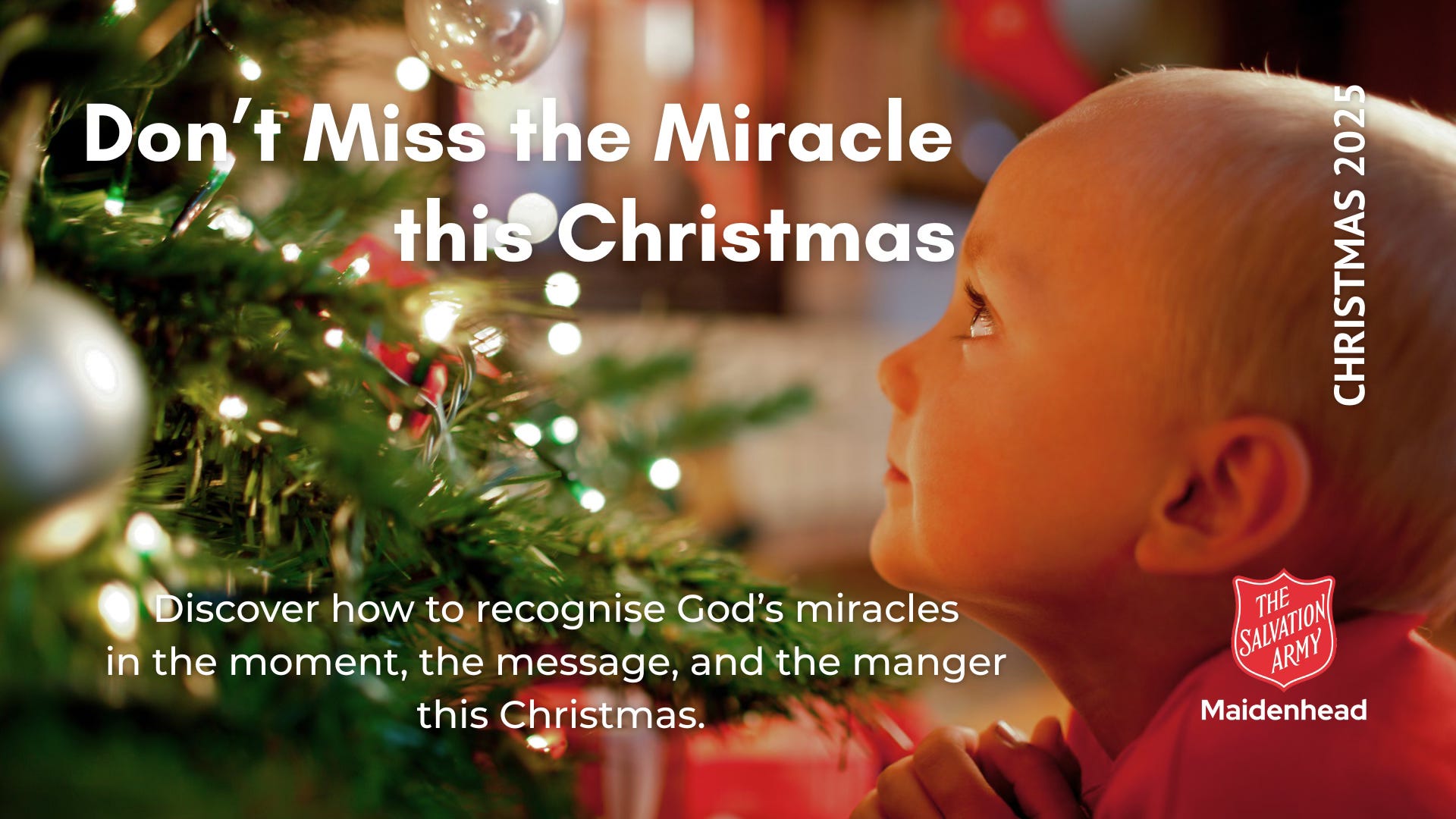
This seven-day journey helps us slow down after the rush of Christmas and notice the presence of Jesus in our everyday lives. Each day takes a fresh angle from the Christmas story, drawing out hope for the days between Christmas and the New Year.
Day 1 reminds us that, like Bethlehem, we can be so busy that we overlook Jesus right beside us.
Day 2 helps us hear heaven’s song of peace even when life feels tired and noisy.
Day 3 (Old Year’s Night) invites us to look back over the year and spot God’s quiet faithfulness.
Day 4 (New Year’s Day) urges us to begin the new year with open hands, ready to receive Christ’s gift of love and hope.
Day 5 shows us that God’s peace reaches into every pressure, fear, or worry we carry into January.
Day 6 calls us to respond to God’s gift, not just hear about it, choosing simple obedience in home, work, neighbourhood, and corps life.
Day 7 encourages us to carry the joy of Christmas into ordinary days so that our lives become a signpost pointing others to Jesus.
Together, these readings help us end the year with gratitude, start the year with trust, and keep Christ at the centre of our daily walk.
Thanks for reading Battle Drill Devotional! Subscribe for free to receive new posts and support my work.
No Room for Jesus. Are You Making the Same Mistake?
Monday 29 December 2025
Doesn’t your life ever feel like a completely crowded city? Every single moment is booked, and every space feels filled. You’ve got a constant stream of notifications, a to-do list that never ends, and a calendar so packed it looks like a jigsaw puzzle. We’re all just rushing from one thing to the next, with that quiet, nagging feeling that we’re forgetting something really important. We’ve all felt it… that hollow sense that in the middle of everything, there’s simply no room. No room to breathe. No room to think. No room to just be.
But what if that feeling of being totally overwhelmed isn’t new? What if this exact problem - this crisis of having “no room” - is hiding right in the heart of the Christmas story? What if the mistake of a long-forgotten town is one we’re still making every single day?
Let’s go back two thousand years, to a dusty, bustling town. A census had been ordered by Caesar Augustus, and the roads were choked with people. A young couple, Mary and Joseph, arrived in Bethlehem, his ancestral home. The town was just overwhelmed with visitors - kind of like how our lives get overwhelmed with obligations. Every spare room, every available space, was already taken.
The Bible tells us something so simple, yet so profound: there was no lodging available for them (Luke 2:7). Now, this probably wasn’t a hotel with a grumpy innkeeper yelling “No Vacancy”! The word used for “inn”, kataluma, often meant a guest room in a private family home. The space was simply full. It wasn’t a mean-spirited rejection, but a thoughtless oversight. It was just the natural result of a town wrapped up in its own busyness and its own priorities. There was just no space left.
And so, the Saviour of the world was welcomed not in a place of honour, but in the quiet humility of a stable - likely a cave where animals were kept. He was laid in a manger, a feeding trough that might have been carved from stone or built of wood, filled with hay. This was the throne chosen for the King of Kings. The sign the shepherds were told to look for wasn’t a palace, but a baby in an animal’s trough - a symbol of shocking humility. The God of the universe didn’t enter our world with a grand entrance, but in the margins, in the one place that was overlooked.
It’s so easy to read this story and judge that crowded town, isn’t it? How could they have missed it? How could they be so preoccupied that they didn’t notice the arrival of God himself? But before we get too critical, we have to hold up a mirror. How often are our own hearts just as full?
Our schedules are packed with work, meetings, and deadlines. Our minds are crowded with worries about the future and anxieties about today. Our calendars are filled, not just with burdens, but with good things - family time, nights out with friends, personal goals. But in our frantic rush to do it all, have we left any room for wonder? Is there any space left for the sacred?
This is the real question for us. In our own lives, have we ever looked at God knocking gently on the door of our hearts and said, without meaning any harm, “I’m sorry, there’s just no room right now”? We aren’t bad people. We’re just busy people. But the outcome is the same. When every room in our soul is occupied, we risk pushing the most important guest of all into the stable.
But here’s the beautiful part. God didn’t turn away from Bethlehem’s busyness. He found room in the margins, in the quiet, overlooked places. And he can do the same in our lives if we just let him. The invitation isn’t to drop all our responsibilities, but to create small, sacred spaces right in the middle of them.
So, I want to invite you to do something right now. Just… be still. Take a slow, deep breath. And in the quiet of this moment, ask yourself one simple question: Where can I make a little room for Jesus today?
It doesn’t have to be some huge gesture. This isn’t about overhauling your entire life overnight. Maybe it’s just five minutes of silence with your coffee before the chaos begins. Maybe it’s choosing to put your phone away on your commute and just be present. Maybe it’s finding a quiet moment on your lunch break to whisper one heartfelt sentence: “Lord, you are welcome here”. Making room isn’t about adding another task to your list. It’s about shifting your posture to one of openness, an awareness that God wants to meet you right where you are.
The world back then had no room for Jesus, and our world today often seems to feel the same way. But the story of the manger is a story of hope. It’s a reminder that Jesus isn’t demanding a palace. He’s happy with a humble stable. He’s not waiting for your life to be perfect or clean or empty. He is simply waiting for an invitation into the life you have right now.
This season, and in all the seasons to come, I hope you find the incredible peace that comes from making just a little bit of room. I hope you discover the manger in your own heart - that quiet, humble space where you can welcome the presence of God. And I hope you hear his gentle whisper in the sacred moments you create for him. Be blessed.
God’s 2000-Year-Old Secret for Modern Burnout
Tuesday 30 December 2025
Feeling chaotic, drained, and running on fumes? What if the secret to burnout wasn’t a new app, but a 2,000-year-old whisper to a group of exhausted shepherds? They were overlooked and stuck in a grind. But one night, they learned how to hear heaven’s song, and it holds the secret to finding your peace.
Let’s be real. Burnout is more than just being tired. It’s the relentless buzz of notifications and the pressure that you’re always on yet still falling behind. It’s the emotional exhaustion from pouring yourself out until there’s nothing left in the tank. It’s that deep, soul-level fatigue where things you used to love now feel like a chore. In a world obsessed with doing more, we feel spiritually disconnected, wondering where God is in all the chaos.
But this feeling isn’t new. Long before we had the word “burnout”, a group of shepherds knew it well. Their life was a loop of routine and stress - working through the cold, dark night, completely isolated. They were outsiders doing an essential but unglamorous job. They were exhausted and felt invisible. Yet, it was into their exhaustion that heaven broke through. History’s most important announcement wasn’t for a king in a palace, but for weary labourers in a field.
The first secret is what the shepherds did: they stopped and listened. Luke chapter 2 says an angel appeared, and the glory of God shone around them. They were terrified, but the angel’s first words were, Don’t be afraid! (Luke 2:10). Then, a choir of angels sang, “Glory to God in highest heaven, and peace on earth to those with whom God is pleased”. (Luke 2:14). In the middle of their exhausting night, heaven’s first message wasn’t “try harder”. It was a proclamation of peace. Peace isn’t something to be earned. It’s a gift to be received. The first step out of burnout is to create moments of stillness to tune into God’s frequency. He’s always broadcasting peace, but our lives are too loud to hear it.
What the shepherds did next is the second secret. They didn’t just talk about the experience. They said to each other, “Let’s go to Bethlehem! Let’s see this thing that has happened, which the Lord has told us about” and the Bible says they hurried off (Luke 2:15-16). This is where rest becomes active. Peace is proclaimed, but it must also be pursued. They left their responsibilities to find the source of peace. For us, that means taking an intentional step toward God - choosing to open the Bible instead of scrolling or choosing to pray instead of letting your to-do list overwhelm you. It’s the act of “going and seeing” for yourself that this peace is real.
The third secret is what happened after they found Jesus. The shepherds returned, glorifying and praising God for all they had heard and seen. (Luke 2:20). They went back to their ordinary lives - the same fields, the same sheep - but they went back changed. Their posture shifted from weary obligation to active worship. This is how we practice peace. Burnout locks our focus on our stress, but worship reorients our perspective to the greatness of God. Gratitude becomes the antidote to fatigue. The shepherds didn’t get a new job, but they got a new song. They returned to their duties with a heart full of praise, and that changed everything.
God’s ancient secret for burnout is a three-part rhythm. First, Tune In: stop and listen for the peace God is speaking. Second, Go and See: actively move toward the source of that peace. And third, Practice Peace: return to your life with praise and gratitude changing your perspective. The shepherds went back to their flocks, but they carried heaven’s song with them. That same peace is available for you.
Let’s pray. Heavenly Father, thank you for your peace. Help us to create moments of stillness to pursue you and build a heart of gratitude. Let us hear your song of peace in our exhaustion and help us carry it with us. Amen.
You Saw the Stress but You Missed God’s Work
Old Year’s Night – 31 December 2025
This past year was a lot, wasn’t it? A blur of pressure and noise that made it easy to feel like God was missing in action. It’s so easy to see the stress and completely miss his work - to see the storm but miss the One walking on the waves.
But before we rush into the next chapter, what if we looked again? What if we paused and asked God for new eyes? I want to give you three reflection prompts to pull back the curtain of stress and see where God’s grace showed up. You might be shocked at just how present he really was.
So, how do we start? We don’t pretend the hard stuff wasn’t real. We choose to look for God in the middle of it. This is an act of faith - hunting for grace in the mess.
The psalmist Asaph did this in Psalm 77. His heart ached, but he pivoted, declaring, But then I recall all you have done, O Lord; I remember your wonderful deeds of long ago. (Psalm 77:11) He chose to let God’s faithfulness speak louder than his anxiety. This discipline of remembering is our anchor. It reframes our story from one of survival to one of his sustenance.
Alright, let’s start with Prompt One. Think back to a moment of unexpected provision. It doesn’t have to be a massive miracle. Maybe a forgotten cheque arrived just when bills were piling up. Or a friend texted the exact words you needed to hear when you felt like giving up.
That moment you thought, “How will I get through this”?...and somehow, you did. That wasn’t luck. That was grace.
So, where did you see God provide for you unexpectedly?
Hold onto that memory. It’s evidence he was closer than you thought.
Now for Prompt Two: look for a moment of unexpected strength. Think of a time you were utterly exhausted - physically, spiritually - and should have fallen apart. But you didn’t. You took the next step with a resilience you couldn’t explain.
This is what Paul meant when God said, My grace is all you need. My power works best in weakness. (2 Corinthians 12:9). That fortitude wasn’t just your willpower. It was his grace.
So, when did God give you strength when you had none of your own?
You weren’t just surviving. You were supernaturally sustained.
As these moments emerge, a new picture appears - not of stress, but of grace.
Finally, Prompt Three: look for a moment of unexpected peace. The Bible calls it a peace which exceeds anything we can understand (Philippians 4:7) - a calm that makes no sense in a storm.
Was there a moment you should have been panicking, but instead felt a strange stillness? Perhaps while waiting for difficult news, you felt a calm that it would be OK, no matter the outcome. These are divine interruptions.
So, where did God grant you peace that defied your circumstances?
That peace is not the absence of a storm, but his presence in it.
Gather these moments - provision, strength, and peace - and the story of your year changes. The stress doesn’t disappear, but you see it’s threaded with grace. You see God was never absent. You didn’t just survive. You were sustained. His faithfulness in your past is the promise of his presence in your future.
Let’s pray.
Father, thank you. Forgive us for doubting you were there. As we look ahead, give us eyes to see your goodness. Thank you for carrying us through. We trust you with the days ahead because we’ve seen your faithfulness behind us. In Jesus’ name, Amen.
You Get to Open This Gift Again Today
New Year’s Day – 1 January 2026
Remember that feeling of a fresh start on 1 January? That burst of hope that this year will be different. But by the second week of January, that feeling can already seem out of reach. Suddenly, the weight of last year - the mistakes, the regrets - feels heavier than the promise of the year ahead.
We tell ourselves, “This year, I’ll be better”. But we’re haunted by the ghosts of resolutions past. The gym membership that went unused. The promise to be more patient, broken in a moment of frustration. It can leave you feeling stuck, wondering if a true fresh start is even possible. You feel like you had your shot, you opened your gift, but now you’re just left with an empty box.
What if the greatest gift you’ve ever received wasn’t a one-time event? What if you get to open it again? Today. And tomorrow. And for every single day of this brand-new year?
There’s a story about the first time this gift was announced. It wasn’t in a palace, but in the middle of a dark, ordinary night to a group of shepherds. Suddenly, an angel appeared, and his first words were, “Don’t be afraid!” ... “I bring you good news that will bring great joy to all people. The Savior—yes, the Messiah, the Lord—has been born today in Bethlehem, the city of David! (Luke 2:10-11).
The greatest news in history wasn’t a new set of rules. It was a person. The gift was God himself.
The shepherds’ response is a model for us. They didn’t second-guess it or wait until they felt worthy. They just went, with open hearts, to receive the gift. That’s the same invitation for you today. Not because you’ve earned it, but because the Giver’s nature is love.
So, what’s inside this gift? The first layer you get to unwrap is new mercy.
There’s a verse in Lamentations that says, The faithful love of the Lord never ends! His mercies never cease. Great is his faithfulness; his mercies begin afresh each morning. (Lamentations 3:22-23). Did you catch that? Afresh each morning.
Imagine waking up to a completely clean slate, where every mistake from yesterday is wiped away. That is the promise of his mercy. It’s not a one-time pardon. It is a daily, recurring gift that’s waiting for you like the sunrise.
When you peel back that layer of mercy, you find a new identity.
The Apostle Paul wrote, This means that anyone who belongs to Christ has become a new person. The old life is gone; a new life has begun! (2 Corinthians 5:17).
A New Year’s resolution says, “I, the same old person, will try harder to get a new outcome”. But God’s gift says you are a fundamentally new creation. The old you - defined by your past, your failures, your anxieties - is gone. Your identity is no longer “sinner trying to be good”. It’s “a new creation learning to live out who they truly are in Christ”. When you stumble, it doesn’t change your identity. You just get to unwrap this gift again and remember the truth.
Finally, at the very heart of this gift is the most precious treasure of all: his Presence.
The name given to Jesus was Immanuel, which literally means “God with us”. The ultimate gift isn’t just forgiveness for our past, but God himself, choosing to be with us, right here, right now.
In every single moment of the next 365 days, you do not have to walk alone. When you feel anxious, his presence is your peace. When you feel lonely, his presence is your comfort. The greatest gift is a relationship with the Giver himself, offering you his constant companionship.
So how do we practically open this gift each day? It’s simpler than you think.
It starts by waking up and consciously choosing to have open hands. Before your feet hit the floor, take ten seconds to simply pray, “Lord, help me receive your love and guidance today”. That simple prayer is you, unwrapping the gift.
Then, practice gratitude. Take just one minute to thank him that his mercies are new and that you are not alone. This small act rewires your brain to look for his goodness.
Finally, get to know the Giver. Read a verse of scripture or listen to a worship song. The point isn’t to check a box. It’s to connect with the Person who is the gift.
Maybe you’ve never truly opened this gift for yourself. Or maybe it’s a gift you received long ago, but it’s been sitting on a shelf, collecting dust.
The invitation from the angel is the same for you now: “Don’t be afraid”. There is good news of great joy waiting for you. If you want to receive this gift of new mercy, a new identity, and his very presence, I invite you to simply open your hands and pray this with me.
Lord Jesus, I admit I’ve been trying to do this on my own. I’m tired of carrying the weight of my past. Today, I open my hands and my heart to you. I receive the gift of your forgiveness and your mercy. I accept the new identity you give me as a new creation. More than anything, I ask for the gift of your presence in my life, today and every day. Thank you for being the greatest gift. Amen.
A true fresh start isn’t found in a date on the calendar, but in a Person.
The beauty of this gift is that its newness never wears off. His mercies will be there for you tomorrow morning. Your new identity in him is secure. And his presence will be your constant companion through every single day of this year. You get to open this gift again, right now. May you live this year not in the shadow of past failures, but in the light of his present grace.
The Peace I Give Is a Gift the World Cannot Give
Friday 2 January 2026
So, you’ve made the vision boards, downloaded the meditation apps, and perfected your budget. You thought if you could just get your life in perfect order, the anxiety would finally go away.
But if you’re here, you’ve probably discovered the truth: the peace this world offers is incredibly fragile. It shatters the moment life doesn’t go according to your perfect plan.
But what if there was another kind of peace? A peace that isn’t built on perfect circumstances but actually thrives in the middle of chaos.
I remember when anxiety becomes my constant shadow. I’m convinced that if I could just control everything, I’d finally be at peace. I’ve hustled for promotions, devoured self-help books, and organised my life down to the minute.
But every time I’ve thought I had it all handled, life would happen. An unexpected bill, a failed project, a surprise health issue. And every time, the peace I worked so hard to build would collapse like a house of cards.
I’ve been exhausted from trying to hold all the pieces of my life together. The world offers me fixes that depend on my circumstances being perfect and my performance being flawless. But life isn’t perfect, and neither am I. I’ve looked for permanent peace from temporary sources, and it’s a recipe for burnout.
My breaking point came during a week where everything felt like it was falling apart. I remember just sitting in my car, crushed by the weight of it all, and whispering, “God, there has to be a better way”.
In that moment of surrender, a verse from the book of John came to mind. Right before Jesus faces the cross - the most stressful situation imaginable - he tells his disciples: “I am leaving you with a gift—peace of mind and heart. And the peace I give is a gift the world cannot give. So don’t be troubled or afraid”. (John 14:27).
Think about that. He’s hours away from betrayal and death, yet he’s talking about giving peace. It just clicked for me: the peace Jesus offers is radically different. It’s not a peace that helps you avoid problems. It’s a peace that sustains you through them.
The peace the world offers is like a calm pond - the tiniest rock sends ripples across the entire surface. The peace of Jesus is like the deep, silent current of the ocean. The surface can be a chaotic mess of crashing waves, but deep down, there’s a powerful, unshakable calm.
This peace isn’t fragile. It’s a guarantee, rooted in a relationship with the One who has already overcome the world. It’s the kind of peace that guards your heart and mind when life makes no sense. It’s not the absence of trouble, but the very real presence of God with you in trouble, quieting your anxious thoughts and calming your deepest fears.
So, how do we actually get this peace? It starts with two mindset shifts that changed everything for me.
First, trade your worries for prayer. Philippians 4 says, Don’t worry about anything; instead, pray about everything. Tell God what you need, and thank him for all he has done. Then you will experience God’s peace, which exceeds anything we can understand. His peace will guard your hearts and minds as you live in Christ Jesus. (Philippians 4:6-7). Instead of letting a worry spiral in your head, you make a conscious choice to hand it over to the One who is infinitely bigger than the problem.
Second, trust God’s provision instead of your own. In Matthew 6, Jesus points to the birds and says the heavenly Father feeds them, asking, And aren’t you far more valuable to him than they are? (Matthew 6:27). This doesn’t mean we become passive. It means our actions come from a place of trust, not a place of fear.
The world’s solutions for anxiety will always leave you striving and exhausted. They demand that you be in control.
The peace that Jesus gives is a gift. You can’t earn it. And because the world didn’t give it to you, the world can’t take it away. It’s a peace that holds you steady, even when the storms of life are raging.
Let’s pray for that peace together right now.
Father, thank you for the gift of your peace, a peace that the world cannot give. I release my anxieties and my need for control into your hands. Help me to trust you, to bring my worries to you in prayer, and to rest in your presence. Guard my heart and my mind with your peace that surpasses all understanding. In Jesus’ name, Amen.
The One Mistake You Can’t Afford to Make After Christmas
Saturday 3 January 2026
The first weekend of the New Year just feels different, doesn’t it? The presents are all opened, the big meal is a memory, the New Year fireworks have been silenced, and the house settles into this quiet hum of… “what now”? We’ve all heard the beautiful story of Christmas. We’ve sung the carols, we’ve seen the nativity scenes. But have you ever thought about the people who were actually in Bethlehem that night? The ones who might have heard the buzz about a special birth… and just went back to sleep?
They woke up the next day, and the day after that, and just fell back into their normal lives, never knowing they were just a few steps away from meeting God in the flesh. They lived right there, so close to a miracle, but missed it. That is the one mistake, the quiet regret, you can’t afford to make after Christmas.
That post-Christmas letdown is a real thing. The hype fades, the decorations will come down soon, and life gets back to its regular rhythm. And if we’re being honest, for a lot of us, our spiritual life kind of follows the same pattern. We hear the Christmas message, feel that little flicker of inspiration, but by the time January hits, nothing has really changed.
It’s the difference between hearing about an incredible gift and actually opening it. And this is the great danger: being a spectator to your own faith. It’s the tragedy of proximity - being so close to something life-changing yet letting it stay a story. The Bible tells us that when the shepherds shared their news, everyone who heard it was amazed. But amazement doesn’t automatically lead to action. And that gap, between hearing and doing, is where faith becomes a skin-deep, once-a-year feeling.
Now, let’s talk about the real heroes of this moment in the story: the shepherds. In that society, shepherds weren’t exactly A-listers. They were ordinary, working-class people, not religious scholars, or royalty. Yet, God chose them to be the first to get the good news. And their response is the secret to avoiding the mistake of doing nothing.
The Bible says in Luke chapter 2 that after the angels appeared, they didn’t just sit around and wonder. They didn’t form a committee or wait for a second opinion. They looked at each other and said, “Let’s go to Bethlehem! Let’s see this thing that has happened, which the Lord has told us about”. (Luke 2:15).
Their reaction was immediate and powerful. First, they said, “Let’s go”. They made a choice. No hesitation, no waiting for a fancier invitation. Second, the scripture says they “hurried”. They had a sense of urgency. This wasn’t a casual walk. It was a sprint towards an encounter with God. They dropped everything for the one thing that mattered most.
Third, they went to see for themselves. They didn’t just take the angels’ word for it. They wanted a personal experience. It’s one thing to hear the message. It’s another thing completely to act on it. The shepherds knew that before they could tell anyone else, they had to meet Jesus for themselves.
Now, compare the shepherds with the rest of the town. When the shepherds came back from the manger, they couldn’t shut up about it. They told everyone what they had seen and heard about this child. And what was the town’s reaction? Luke 2:18 says, All who heard the shepherds’ story were astonished.
They were amazed. Stunned, probably. But the Bible doesn’t mention a stampede from the town square to the manger. They heard the news, they thought, “Wow, that’s incredible”, and then... crickets. They were so close, but they chose to stay spectators. They heard the greatest news in human history but were too busy, too distracted, or maybe just too comfortable to walk a few streets and see for themselves. This is the silent regret of Bethlehem. It’s the mistake of hearing Good News but never letting it become yournews. It’s letting the most important event in history be something you just heard about, instead of something you experience firsthand.
So, how do we keep from making that same mistake? How do we shake off that spiritual complacency and leave Bethlehem’s regret behind? We have to follow the shepherds’ lead. We have to create our own “Let’s go” moments.
It’s all about shifting from passively hearing to actively responding. Your “Let’s go” moment could be deciding to finally read the Gospels for yourself. It might be finding a church community where you can actually connect. Maybe it’s committing to prayer, not as a chore, but as a real conversation. Or maybe it’s serving someone in need and putting your faith into action.
The shepherds went, they saw, and they came back celebrating God, their lives totally changed. The message of Christmas was never meant to be just a comforting story we pull out once a year. It’s a call to action. It’s an invitation to an encounter that will change your ordinary, everyday life.
Don’t let this be just another Christmas where the story is over on 25 December. The real question is, what are you going to do a week or so after, as you enter a New Year?
So, I want to challenge you. What’s one step, one “Let’s go” moment, you’ll commit to this year to act on the news you’ve heard? Drop it in the comments below. Let’s build each other up as we move from being spectators to being participants.
And if this hit home for you, subscribe for more content that helps you live out your faith - not just at Christmas, but every single day. Don’t just hear the story. Go live it.
Don’t Let Your Christmas Joy Die This January
Sunday 4 January 2026
You know that quiet, kind of sad moment that hits every January? It’s when the last of the Christmas lights come down, and suddenly the house feels a little darker, a little emptier. That incredible feeling - the magic, the peace of Christmas - starts to feel like a distant memory, like a temporary high that just fades with the Christmas decorations. For many, the good cheer of the season seems to come to a sudden stop. But what if it didn’t have to? What if the key to turning a seasonal feeling into a year-long light was given to us by the most unlikely people in the whole Christmas story? A bunch of shepherds in a field.
You can find the story in the gospel of Luke, chapter 2. While the world was busy, distracted, and probably stressed, a group of shepherds were just… at work. They were out in the fields, doing their normal, everyday job of watching their sheep at night. They weren’t trying to force some big spiritual moment. They weren’t at a special event or trying to create the perfect holiday vibe. They were just there, living their ordinary lives.
And that’s exactly where God showed up. An angel appeared, and the glory of the Lord literally lit up the night around them. And right there is the first secret of the shepherds: lasting joy doesn’t show up when we demand it. It finds us when we’re available for it. God chose to give the biggest news in history to a group of regular guys on a totally normal night, not because of who they were, but because they were humble and simply present.
This January, there’s always this pressure to “get back to normal”. But what if, instead, we just chose to be available? What if we realised that the deepest joy doesn’t come from the big, spectacular moments we try to create, but in the quiet ones where we’re open to God interrupting our daily routine? Real joy often shows up when we’re simply open to it, not when we’re trying to manufacture a feeling.
Now, when the angel delivered the “good news of great joy”, the shepherds were, understandably, terrified. But that terror quickly turned into total awe. And what was their very next move? The Bible says they told each other, Let’s go to Bethlehem! Let’s see this thing that has happened, which the Lord has told us about. (Luke 2:15). And then, it says, they “hurried”.
They hurried. They didn’t second-guess it. They didn’t say, “Let’s check our calendars”. They didn’t form a committee. Their awe sparked immediate action. And that’s the second secret: joy that lasts requires us to do something. It’s not a passive feeling we just get to soak in. It’s a catalyst that pushes us forward. The shepherds’ immediate reaction is a powerful example for us.
That “Christmas high” so many of us feel often fades because we treat it like a battery that’s just going to run out. We think the feeling is supposed to carry us. But the shepherds show us that we’re supposed to carry the message. When you get that little nudge in your heart - to pray for someone, to send an encouraging word, to forgive, to serve - do you act on it quickly? Or do you wait until the feeling fades? A joy that lasts is a joy that’s acted on.
After they saw the baby in the manger, just like the angel had said, the shepherds didn’t just quietly go home and call it a night. Scripture says they After seeing him, the shepherds told everyone what had happened and what the angel had said to them about this child. (Luke 2:17). And after that, as they were walking back to their fields, they were glorifying and praising God for all they had heard and seen. (Luke 2:20). Their joy wasn’t just some internal, private feeling. It became an active, outward explosion of worship and storytelling.
This is the final, and maybe most important, secret: joy was never designed to be a private treasure. It’s meant to be a public testimony. The shepherds turned their personal encounter into a shared story that left other people amazed. When we hoard our “Christmas joy” for ourselves, it has a shelf life. It stays a feeling. But when we share it, it becomes a witness. It becomes light.
The fact that they went back to their normal jobs, but were completely changed by what they saw, shows us that these divine moments are meant to transform how we live in our everyday world. Their joy became a signpost pointing others toward Jesus. Joy multiplies when it’s given away. It goes from being an internal feeling to an external witness the moment it’s shared.
So, how do we actually do this, right now, in the middle of January? We follow the path the shepherds laid out.
First, be available. Stop chasing a feeling. Instead, build a little space into your ordinary day. Maybe that’s five minutes of quiet in the morning before the chaos starts or keeping a small journal to notice where God is showing up in the little things.
Second, act with haste. When you feel that prompt from God, move. Don’t overthink it. Pay for the coffee for the car behind you. Send that text you’ve been putting off. Make the call. Turn your sense of awe into action before it has a chance to fade into apathy.
Third, share your story. Your joy is supposed to be a witness. It doesn’t have to be a big, formal speech. It can be as simple as telling a friend how God came through for you. It can be living with a sense of peace that makes a coworker ask, “What’s different about you”? Your life becomes the story that makes other people wonder.
The shepherds went back to their same jobs and their same boring fields, but they were not the same people. They carried the light of that holy night with them, right back into their routine. That incredible feeling we get at Christmas wasn’t meant to be a temporary high. It was meant to be the starting line for a new way of living - a life of availability, action, and witness.
So, this year, don’t pack up the joy of Christmas with the ornaments and the lights. Let this January be your field, just like it was for them. Let it be a place where you don’t just remember the light, but you carry it, you act on it, and you share it - praising God right in the middle of your ordinary, everyday life.
As we close this long journey of 35 days from Advent to Christmas and into a fresh New Year, my prayer is that you hold on to the wonder you’ve seen again and again. That you will hold on to the God who comes at the right moment , who speaks your language so you can hear his heart , who works in ways you may not understand yet can always trust , who meets you in the rush and offers peace and presence , and who steps into the world so you can know him and follow him with confidence and hope. As you step into the days ahead, may you keep your eyes open for his quiet miracles, your ears open to his gentle voice, and your heart open to his shaping grace. I pray that as you look back over this special season, you can say with certainty, “I have not missed the miracle this Christmas”. God is with you - in your home, your workplace, your neighbourhood, your corps or church family, and every place you go. Walk into this New Year with joy. Christ goes before you, walks beside you, and will never let you go.
For more devotionals and resources, visit battledrilldevotional.com. Prefer watching? Check out our video devotionals at video.battledrilldevotional.com. Sign up via email at devotional.battledrilldevotional.com. See our Sermons at battlereadysermons.com. Sign up via email at sermons.battlereadysermons.com.
Unless otherwise shown, all Scripture quotations are taken from the Holy Bible, New Living Translation, copyright 1996, 2004, 2007, 2015 by Tyndale House Foundation. Used by permission of Tyndale House Publishers, Inc., Carol Stream, Illinois 60188. All rights reserved. All song extracts used by permission. CCL Licence No. 135015.