

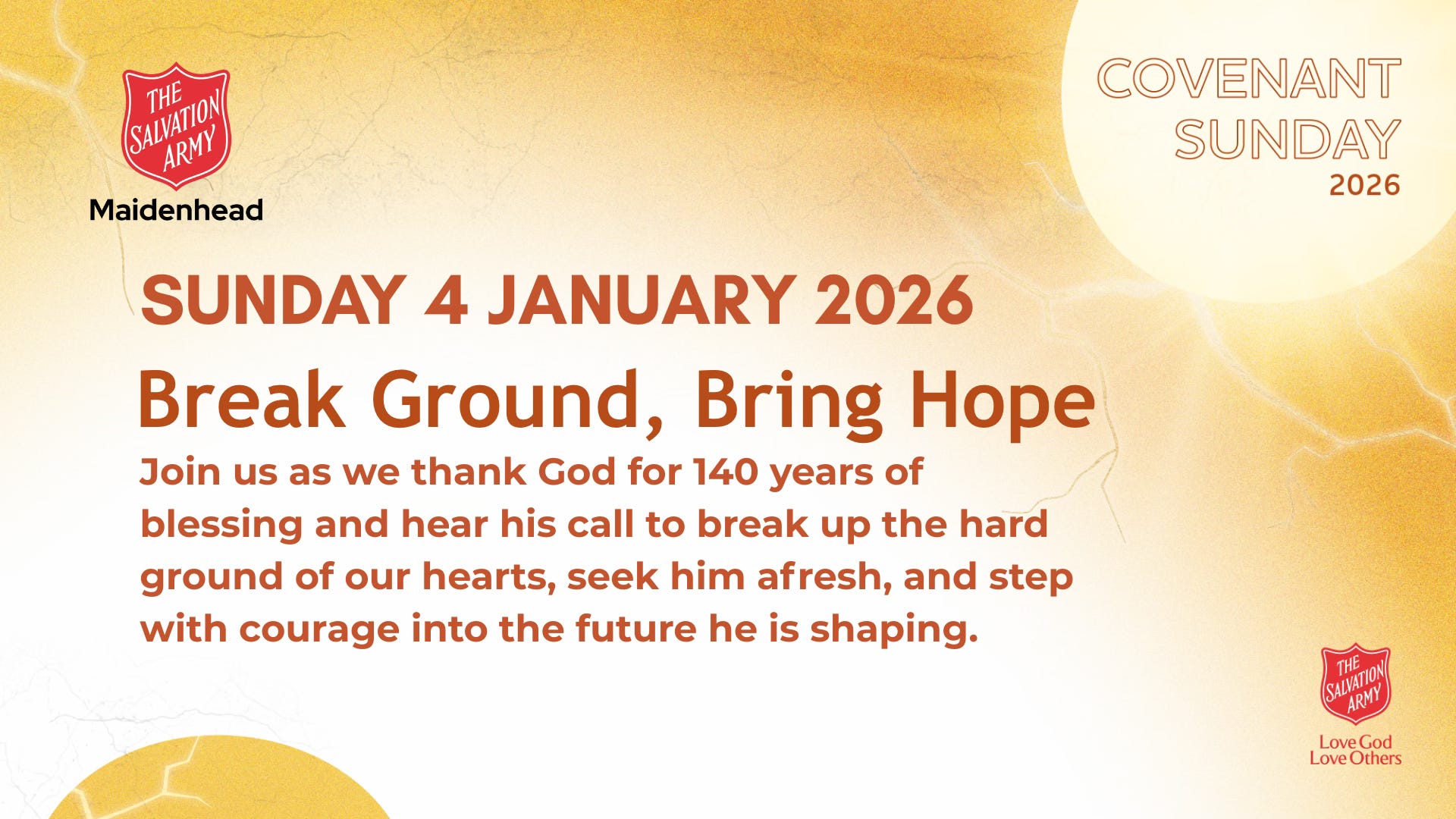
This seven-day journey walks you through Hosea 10 and asks an honest question: have our hearts – and our corps or church – grown hard or settled for maintenance mode? Each day helps you look back with gratitude, face any weeds or hard ground, and then choose fresh repentance, new seeds of righteousness, and a renewed hunger to seek the Lord. It’s a simple, hope-filled call to let God dig deep so he can pour out new life on you, your corps, and your community.
Thanks for reading Battle Drill Devotional! Subscribe for free to receive new posts and support my work.
The Hidden Danger of God’s Blessings
Monday 5 January 2026
You prayed for it. You waited for it. And then - bam, it happened. God came through in a huge way. The promotion, the healing, the breakthrough you were so desperate for… it finally showed up. The celebration was real, the gratitude was deep, and you felt closer to him than ever.
But what happens after the party’s over? When the memory of the blessing becomes clearer than the presence of the One who gave it? There’s a subtle danger that creeps in when we only look back at what God has done - a danger that can stop our future spiritual growth dead in its tracks. Let’s get into it.
It’s a story many of us know by heart. We get this spiritual high after a powerful moment of God’s goodness, but then, before we know it, we’re stuck on a spiritual plateau. The fire starts to fade. Daily prayer and reading the Bible begin to feel more like a chore than a lifeline. We’re still grateful, obviously. We’ll tell the story of that blessing to anyone who will listen. But we’re living off the spiritual calories of a past feast, and we’re slowly starving.
This doesn’t mean your faith is fake or that God has packed up and left you. It’s a common spiritual state where our gratitude for what was accidentally elbows out our faith for what’s next. We become curators of a museum of past blessings, constantly polishing the display cases and admiring the proof of God’s faithfulness. All the while, the workshop next door, where he wants to build new things with us, sits completely empty. That right there? That’s spiritual stagnation, and it’s a dangerous place to live.
This isn’t a new problem. The Bible gives us a really sharp warning about this through the prophet Hosea. In chapter 10, he calls Israel a “luxuriant vine” that was “loaded with fruit.” God had blessed them like crazy. They had prosperity, they had success, they had everything they thought they wanted. But then Hosea points out something disturbing: “But the richer the people get, the more pagan altars they build”.
The more God blessed them, the more they drifted toward idols. Their blessings became a distraction that led them to rely on themselves. They started worshipping their own comfort, their own success, the work of their own hands. The very fruit of God’s goodness became the raw material for their idols. Their prosperity didn’t pull them into a deeper devotion. It lulled them into a dangerous complacency. They forgot that God was the source of it all and started to think they were the ones making it happen. It’s a timeless warning: when we fall in love with the gifts more than the Giver, we start a slow drift into idolatry.
Right about now, you might be thinking, “So, wait, am I not supposed to celebrate and remember what God has done?” Of course, you should! Absolutely. In 1 Samuel, after a mind-blowing victory, the prophet Samuel sets up a stone as a memorial. He names it “Ebenezer,” which means “stone of help,”and declares, “Up to this point the Lord has helped us!” (1 Samuel 7:12).
This is the key. We are called to put up these “stones of remembrance” in our lives. They are vital. But you have to catch the critical phrase: “Up to this point.” It’s a statement that honours the past without thinking the journey is over. A milestone is not the destination. An Ebenezer stone is meant to be a foundation you build on, not a final resting place you settle on. It’s a powerful reminder that the same God who brought you this far is ready and willing to take you further.
So how do we switch from being a museum curator to being a construction partner with God? How do we break out of that spiritual stall? Hosea 10:12 gives us the blueprint: “Plant the good seeds of righteousness, and you will harvest a crop of love. Plough up the hard ground of your hearts, for now is the time to seek the Lord”.
First, we’ve got to shift our posture from reflection to expectation. It’s the difference between saying, “Lord, thank you for what you did,” and asking, “Lord, what are we doing next?” That simple change in how we talk turns our gratitude from a conclusion into a catalyst. It wakes up our faith and signals to God that we’re ready for the next assignment.
Second, we have to practice active dependence. Blessings can create an illusion that we’ve got it all under control. So, we have to intentionally put ourselves in situations where we’re forced to depend on God again. Maybe that’s mentoring someone, joining a ministry that stretches you, or setting a goal so big you know you can’t possibly do it alone. Don’t let your comfort become a cage.
Finally, we have to re-centre our worship on the Giver, not just the gifts. This means carving out time to praise God just for who he is - his holiness, his justice, his mercy - not just for what he’s given you. This practice is what guards our hearts from the subtle idolatry of blessings and keeps our love set firmly on him.
Your story of God’s faithfulness isn’t meant to be a closed book sitting on a dusty shelf. It’s a living, breathing testimony that’s still being written. We have to celebrate the victories God gives us, but we can’t park there. The same God who gave you the win in your last season has a new blueprint for this one. It’s time to break up that fallow ground, seek his face, and get ready for whatever he wants to do next.
5 Signs Your Church Became a Museum Not a Mission
Tuesday 6 January 2026
Have you ever walked into a corps or church and felt like you were stepping back in time? And I don’t mean that in a good way.
There’s a subtle shift that can happen in a church - it’s not a sudden crisis, but a slow, quiet fade. The energy that once fuelled risky, life-changing ministry now gets spent just preserving its own history. The focus drifts from the people you’re trying to reach to the preferences of the people you’ve already got. A creeping nostalgia sets in, and suddenly the past is the hero of every single story.
This forces every leader and committed member to ask a terrifying question: are we curating a museum, or are we fuelling a mission? Are we called to be guides of the past, or soldiers for the future?
A church is supposed to be a living, breathing movement, not a mausoleum of tradition. But the line between revering history and being embalmed by it is dangerously thin. So, let’s break down five signs that your corps or church might be more of a museum than a movement, and talk about what it takes to get back on mission.
Sign 1 - The Budget is for Curators, Not Missionaries
Alright, the first and maybe the most painfully obvious sign is all about the budget. Just follow the money. A church on a mission asks, “Where is God calling us to go?” and the budget is the fuel to get there. A church that’s a museum asks, “What will it take to keep the lights on and the building from falling apart?”
In a museum-church, the vast majority of the budget flows inward. It’s spent on staff, on buildings and facilities, and on programmes designed to keep existing members perfectly comfortable. There’s little to no money for risk, for bold new outreach, or for any significant investment in the actual community surrounding the building. When your budget meetings are dominated by conversations about maintenance and preservation instead of mission and multiplication, it’s a clear sign you’re functioning as a curator, not a missionary. When pounds are valued more than disciples, you’re not funding a mission. You’re funding a social club.
Sign 2 - The Past is the Undisputed Hero
Sign number two: The past is the undisputed hero of every story.
Listen to the stories people tell. In a missional church, they’re buzzing about recent life-change - what God is doing right now. But in a museum-church? It’s all about the “glory days.” Every conversation seems to drift back to “remember when...” or “back in our heyday...” or “The Army isn’t what it used to be!”
This isn’t just harmless nostalgia. It’s a sign that the church has stopped dreaming and has lost its vision for the future. When the highlight reel is 60 years old, it means no new highlights are being made. A church sent by God is always looking forward to what God will do next. A museum, by its very definition, is focused on what has already been done. When a church would rather die than change, it usually gets its wish.
Sign 3 - The Members Act Like Guards, Not Guides
This brings us to sign number three: Your members act more like guards than guides.
Think about how new people are treated. In a missional church, newcomers are seen as the entire point. Members act as guides, intentionally connecting with visitors and helping them find their place in the mission.
But in a museum-church, members often behave like guards protecting the exhibits. They might be friendly enough to each other, but they ignore people they don’t recognise. Visitors are welcome to look, but they’re subtly expected not to “touch” anything. They accidentally sit in “someone’s chair.” They don’t know the unwritten rules. Their new ideas aren’t seen as fresh perspectives, but as threats to sacred traditions. When the comfort of the insiders consistently wins out over the welcome of the outsiders, you’re not running a hospital for the broken, you’re guarding the relics of the comfortable.
Sign 4 - Innovation is Feared More Than Irrelevance
You know the unwritten rule of any museum: “Do not touch the displays.” Sign number four is when that same rule applies to your church’s methods, styles, and programmes. Any suggestion for change is met with the seven last words of a dying church: “We’ve never done it that way before.”
Missional churches are constantly adapting to better reach their community. They understand that while the core message never changes, methods absolutely must. A museum-church, however, is terrified of the future and clings to the past. It prioritises preserving traditions - even the totally ineffective ones - over taking the necessary risks to reach a new generation. It would rather be faithful to its methods than fruitful in its mission.
Sign 5 - You Celebrate Maintenance, Not Life-Change
And the final sign, number five, is all about what you celebrate. What are the “wins” that get the spotlight on Sunday morning?
In a museum-church, the big celebrations are about maintenance. “We’ve balanced the budget!” “We finally repaired the roof!” “It’s our 140th anniversary!” Now, these aren’t bad things to celebrate, but if they’re the only things you celebrate, it’s a huge red flag.
A missional church is obsessed with life-change. It celebrates when someone makes a commitment to God. It tells stories of people serving the poor, of marriages being healed, and of community members finding faith. The scoreboard isn’t just attendance numbers and budget surpluses. It’s transformed lives. When a full building is celebrated more than a fulfilled mission, it’s a sure sign that past blessings have bred present complacency.
So, let’s recap: the budget is for curators, the past is the hero, members are guards, innovation is feared, and you celebrate maintenance over ministry.
Look, if any of this feels a little too close to home, don’t be discouraged. This diagnosis isn’t a death sentence - it’s a wake-up call. It’s an invitation from God to move from being a graveyard of yesteryear to being a living, breathing movement once again. It begins when leaders and members get gut-level honest and ask, “What is God up to in our town, and how can we get in on it?”
Spotting the Poisonous Weeds
Wednesday 7 January 2026
What if the biggest threat to your church isn’t some force trying to break down the doors from the outside? What if it’s a quiet poison already growing inside the walls? It’s so easy to focus on external dangers that we completely miss the silent, toxic weeds of complacency and tradition choking the life right out of our corps or church family. A church can look busy. It can sound active. But underneath all that activity, a spiritual stagnation can set in, and just like standing water, it invites decay and disease. So today, let’s learn how to spot these poisonous weeds, with the prophet Hosea as our guide.
First up is the weed of empty words. Hosea 10:4 gives this startling picture from God: “They spout empty words and make covenants they don’t intend to keep. So injustice springs up among them like poisonous weeds in a farmer’s field”. It’s a community where promises have gone hollow and commitments are false.
What does that look like in the church today? Oh, we’ve seen it. It’s the grumbling about a new ministry that God is obviously blessing. It’s the small, unresolved grudges that poison relationships and stop teamwork in its tracks. It’s that enthusiastic “yes!” in a meeting that’s followed by… crickets. Zero action. These aren’t just harmless habits. They’re poisonous weeds. They create an atmosphere where injustice - the very opposite of God’s character - starts to grow where righteousness should be flourishing.
The prophet James warns us about being dividing our loyalty between God and the world (James 1:8) which makes a person unstable in everything they do. These empty words and broken promises show a divided heart. The antidote? Integrity. It’s that simple and that hard. It means choosing to be people whose “yes” means “yes,” whose commitments are actually kept, and whose words build others up instead of tearing them down. We have to get serious about pulling these weeds of insincerity out of our hearts and out of our church.
The second weed is sneakier and, honestly, one of the most dangerous: I call it toxic nostalgia. It’s really just a form of self-reliance. Hosea 10:13 warns, “But you have cultivated wickedness and harvested a thriving crop of sins. You have eaten the fruit of lies—trusting in your military might,
believing that great armies could make your nation safe”.
So, what is this “fruit of lies” they were eating? It’s the lie that our ways are better or safer than God’s ways. And one of the most common forms of this lie in the church is the false security of tradition. It’s that voice that insists, “But we’ve always done it this way!” It’s when we idealise the past so much that it gets in the way of what God is doing right now. Listen, we honour the pioneers who came before us not by perfectly preserving all their methods, but by continuing their mission with the same kind of radical faith they had.
The moment a corps or church starts trusting its own history or its comfortable routines more than the living, active voice of God, it has started to eat the fruit of lies. Complacency sets in - we feel satisfied, all the while being totally unaware of the danger we’re in. We end up trading God’s commands for human traditions. The solution? We have to hold our traditions up to the light of Scripture and ask the hard question: “Does this still help us fulfil the Great Commission? Or has it just become a comfortable idol?”
This brings us to our third weed: fear. And fear has a nasty habit of growing a “root of bitterness.” The book of Hebrews warns us about this: “Look after each other so that none of you fails to receive the grace of God. Watch out that no poisonous root of bitterness grows up to trouble you, corrupting many”.A bitter root isn’t just a bad attitude. The writer is talking about a source of evil inside the church that can poison the whole community. And so often, this root springs from fear - fear of taking a risk, fear of change, fear of losing control.
This kind of fear leads to spiritual paralysis. It stops a church from taking the risks that are essential for the Good News. It makes us shy away from the very challenges we need to grow. And when a church runs on fear instead of faith, that fear eventually sours into bitterness. Bitterness towards leaders trying to move forward. Bitterness toward new people who shake things up and make things messy. Even bitterness towards God for not keeping everything safe and comfortable. And that bitterness is a poison that will cause trouble and divide everyone.
So, what’s the antidote? Hosea gives it to us just a few verses earlier: “Plant the good seeds of righteousness, and you will harvest a crop of love. Plough up the hard ground of your hearts, for now is the time to seek the Lord”. Breaking up hard, fearful, bitter ground takes courage. It takes a radical trust - not in our own strength, but in God’s power. It’s an active choice to sow faith instead of fear, and to reap love instead of bitterness.
These weeds are real, and they can show up in any corps or church. So, let’s get personal for a second. Take some time to reflect. What weeds might be growing in your own heart? In the life of your corps or church? Empty words, toxic nostalgia, and bitter fear. These are the weeds that can quietly choke the life out of a corps or church. They love to grow in the soil of complacency and self-reliance. But here’s the good news: we serve the Master Gardener. He is ready and willing to help us spot and uproot every single one. Let’s pray that he gives us the wisdom to see them clearly and the courage to finally pull them out, so we can become a church that produces a harvest of righteousness for his glory.
Naming The Hard Ground in Your Heart
Thursday 8 January 2026
So, you’re doing all the “right” things... you pray, you try to read your Bible, you even show up for church. Then why does God feel a million miles away? If you feel like you’re just going through the motions, like your spiritual life is stuck in neutral, the reason might not be what you think. What if the truth is that your heart isn’t hardened by some great evil, but by the very real, and very normal, hurts that life has thrown at you? If that sounds like you, it’s time to face it.
There’s a line in the book of Hosea that has always captivated me. In chapter 10, God tells his people to “Plough up the hard ground of your hearts.” (Hosea 10:12). That image is so powerful. He’s not talking to people who are openly rebelling. He’s talking to his own people, folks who had a history with him. He’s describing a heart that was once good soil - soft and fruitful - but over time has become hard, neglected, and barren.
That’s what spiritual distance so often feels like, doesn’t it? It’s not a sudden explosion, but a slow compaction. It’s that worship meeting where you feel nothing. It’s the prayer that feels like it just hits the ceiling. It’s that quiet, resigned thought that says, “I guess this is just how it is now.” This hard ground is land that could be fruitful, but for whatever reason, has been left untended. It’s fallow ground. And when the ground is hard, even if God sends the rain of his presence, it just runs right off without ever sinking in.
So how does the ground get hard in the first place? We usually assume a hard heart comes from some big, rebellious sin. And sure, sometimes it does. But I think it more often comes from a place that’s much more subtle. The ground of our hearts gets hard not overnight, but layer by layer. It’s the disappointment when a prayer wasn’t answered the way we’d hoped. It’s the sting of being betrayed by someone we trusted. It’s the simple weariness from a long, difficult season.
Life happens. People hurt us. We get tired. And if we don’t intentionally deal with those things, we do something to protect ourselves: we build a wall. We stop feeling so deeply. It’s a survival mechanism. But that wall, that hard ground, also keeps out the very presence of God we’re longing for. The writer of Hebrews warns us to be careful not to be “hardened through the deceitfulness of sin.” (Hebrews 3:13).The deceit is that this hardness feels like protection, but it’s slowly leading to an unbelieving heart that turns away from God.
So, what do we do? Hosea gives us the answer: “Plough up the hard ground.” Ploughing is intentional, difficult work. It’s all about breaking up what has become compacted so the soil can be soft enough to receive the seed of God’s Word again. And the very first step of ploughing is simply to name the ground.
You can’t plough a field until you know which one has been left untended. In the same way, you can’t soften your heart until you identify what, specifically, has hardened it. This is an act of incredible courage. It means pausing and asking the Holy Spirit, “Show me, what is the hard ground in my heart? What’s the hurt I’ve buried? What disappointment have I stopped talking to you about?”
This isn’t about blaming God or wallowing in self-pity. It’s about being honest. It’s about bringing those specific hurts out into the light and naming them, one by one. “God, my heart grew hard when I felt abandoned in that situation.” “My heart grew hard when that person’s words cut me so deeply.” “My heart grew hard when I felt like my prayers just went unanswered.” This is the honest, hands-in-the-dirt work of turning back to him.
But here is the beautiful, incredible promise: the work of ploughing is not something you do alone. In Ezekiel 36:26, God makes one of the most stunning promises in all of Scripture: “And I will give you a new heart, and I will put a new spirit in you. I will take out your stony, stubborn heart and give you a tender, responsive heart”.
A heart of stone is hard, cold, and unresponsive. But a heart of flesh? That’s alive, tender, and able to feel. It’s a heart that’s sensitive to God’s voice. When you do the courageous work of naming your hurts, you are making space for God to perform this divine surgery. You are allowing his grace to get into those cracked, hardened places and begin to make you new. That is the miracle of grace.
The journey back to a soft heart begins with one small, honest step. It starts with calling the hard ground by its name. Your spiritual life was never meant to be about just going through the motions. It was meant for deep, vibrant connection with the living God.
So here is your call to action for today. Take one small step. Sometime today, find a quiet moment, maybe with a journal, and just ask the Holy Spirit: “Show me one piece of hard ground in my heart.” Then, write down whatever comes to mind. Don’t analyse it or try to fix it. Just name it. That’s the first turn of the plough.
Let me pray for you. God, I thank you for every single person engaging with this. I ask that you would give them the courage to look at the hard ground in their hearts. Holy Spirit, would you gently show them what needs to be broken up? And as they take that step of faith, I pray that you would begin your divine work of taking out the heart of stone and giving them a new, soft heart of flesh. Soften their hearts, Lord, so they can feel your love again. In Jesus’ name, Amen.
The Uncomfortable Grace You Might Be Avoiding
Friday 9 January 2026
Have you ever felt completely and utterly stuck in your spiritual life? I mean, you’re praying, you’re reading your Bible, you’re doing all the “right” things... but nothing’s changing. It feels like you’re walking through spiritual quicksand, and every single step is just exhausting. If you feel distant from God, know this: you are not alone, and those dry spells are a normal part of the journey.
But what if the secret to getting unstuck isn’t about trying harder? What if the breakthrough you’re so desperate for is wrapped up in a kind of grace you’ve actually been avoiding… an uncomfortable grace?
We love to think of grace as a soft, comforting blanket. And it absolutely is. But sometimes, grace doesn’t feel like a blanket. It feels like a sharp, disruptive plough. When we’re stuck, it’s usually not because God has abandoned us. It’s because he’s inviting us to go deeper, and that means he has to break up the hard ground in our hearts first. The prophet Hosea put it this way: “Plough up the hard ground of your hearts, for now is the time to seek the Lord, that he may come and shower righteousness upon you.” (Hosea 10:12).
This “unploughed ground” is that part of our heart that’s grown hard and unproductive. It’s the soil of our soul that’s been left alone for so long that it’s all packed down, choked with weeds, and can’t receive anything new. This is where we bury our secret sins, our hidden fears, our old wounds, and our favourite idols. We avoid ploughing this ground because, let’s be honest, it hurts. It means turning over the dark, messy underside of our stories and confronting things we thought we could keep hidden. We’re afraid of what that plough will dig up. And so, we stay stuck, wondering why nothing ever seems to grow.
This is where uncomfortable grace changes everything. God doesn’t call us to this painful work to punish us. He calls us to it because he wants to prepare us for a harvest. He sees all the potential in our lives - the love, the joy, and the peace he wants for us - but he knows it can’t grow in hard, stubborn soil. The plough of conviction isn’t God’s anger. It’s his grace, getting the ground ready for new life. It’s his loving hand clearing out whatever is getting in the way of our relationship with him.
So, when God puts his finger on a habit, a relationship, or an attitude in your life, it can feel jarring. That discomfort isn’t a sign that he’s mad at you. It’s the gentle but firm pressure of his grace, showing you exactly where the hard ground is. God is far more interested in our character and our growth than he is in our comfort. That spiritual growing pain you feel is often God challenging what you believe, inviting you to a deeper level of trust. He’s not just giving you what you want. He’s giving you what you truly need. And often, what we need most is a loving disruption.
So, how do we actually cooperate with this uncomfortable, transformative work? It really boils down to three simple choices.
First, you have to invite the plough. Instead of running from the discomfort, lean into it with prayer. One of the bravest prayers you can ever pray is from Psalm 139: “Search me, O God, and know my heart; test me and know my anxious thoughts. Point out anything in me that offends you, and lead me along the path of everlasting life.” (Psalm 139:23-24). This prayer is you handing the plough’s handle over to God. You’re giving him permission to dig deep and show you what’s really going on inside.
Second, practice confession as a way of cleansing. When God’s Spirit points out an “offensive way” - a root of bitterness, an idol of control, a hidden sin - your response isn’t to hide in shame. It’s to agree with God. That’s all confession is. And 1 John 1:9 promises that when we do, he is faithful to forgive us and cleanse us. Confession is how we clear away the rocks and debris that the plough has unearthed.
Finally, embrace the brokenness. A broken and contrite heart is the offering God truly wants. This doesn’t mean being emotionally shattered. It means the hard, prideful ground of your heart has finally been made soft, humble, and ready to receive. That’s the whole point of the plough - to create a heart that is ready for the good seeds God wants to plant.
Feeling spiritually stuck is not a sign that you’ve failed. It’s an invitation. It’s a sign that there might be more that God is asking you to surrender. The discomfort you might be feeling isn’t the absence of God’s grace - it’s the very proof of it. It is his love in action, refusing to let you stay where you are. He wants to do something new in you, but that requires breaking up the old ground first.
Let me pray for you.
Father, thank you for your uncomfortable grace. Thank you that you love us way too much to leave us stuck. Right now, we invite you to search our hearts. Give us the courage to look at what you show us and the humility to turn from it. Break up our unploughed ground, Lord, and plant your righteousness in our lives, so we can finally reap a harvest of your unfailing love. Amen.
Stop Sowing These 3 Seeds Immediately
Saturday 10 January 2026
Did you know you’re a gardener? Every single day, whether you realise it or not, you’re planting seeds in the garden of your life. But what if some of those seeds, the ones that seem totally harmless, are actually weeds in disguise, choking out the good things you’re trying to grow?
We’re about to expose three of these “hidden” seeds - subtle habits that most of us are guilty of planting every day. And I’ll show you how to stop planting seeds of regret, so you can start planting with real purpose.
The Bible gives us a principle that’s as true as gravity: You will always reap what you sow. That’s not a threat. It’s just how life works. And the trick is, the most destructive seeds aren’t always the big, obvious sins we know to avoid. They’re the small, sneaky habits that just creep into our daily lives. Let’s dig up the first one.
First up, we’ve got to stop planting the Seed of Passive Complaint. And man, this one is sneaky because it feels so justified, doesn’t it? The traffic is awful, the weather stinks, our boss is driving us crazy... it feels harmless to vent, right? But every time we do, it’s like we’re salting the earth in our own garden. Every complaint, big or small, sows a seed of bitterness and feeling powerless.
When you’re constantly focused on what’s wrong, your heart just gets hard. It’s almost impossible for gratitude or joy to find any room to grow. Complaining is a habit that trains our eyes to see only the problems, ignoring God’s power and presence right in the middle of them. It magnifies the issue and minimises our God.
So, what’s the fix? You have to flip the script and intentionally plant Seed of Proactive Gratitudeinstead. Instead of complaining, try praying. Instead of focusing on what you don’t have, thank God for what you do. This isn’t about pretending problems aren’t real. It’s about choosing where to focus your energy. Do you want to water the weeds of frustration or plant seeds of righteousness?
So, here’s a practical challenge for you. For the rest of today, the moment you catch yourself about to complain - just pause. In that little gap, find one thing - just one tiny thing - to be grateful for instead. You’re literally breaking up the hard, unploughed ground of your heart and making it ready for a harvest of peace.
Alright, the second seed is one that our modern world basically begs us to plant 24/7: the Seed of Idle Consumption. You know what this is. It’s the endless scroll on your phone, the next episode automatically playing, filling every quiet moment with noise. We call it “relaxing,” but it isn’t really rest. It’s more like a spiritual anaesthetic. We fill up on so much junk food for the soul that we can’t hear God’s voice anymore.
This seed promises connection but often leaves us feeling more isolated. It promises entertainment but steals our attention and our time. Think about it - Hosea 10:12 says to “Plant the good seeds of righteousness,” but how can we do that if our hands are always glued to our phones? We can’t plant good seeds when we’re constantly consuming spiritual junk food.
The antidote is simple, but not easy: Plant the Seed of Intentional Stillness. And this doesn’t mean you need to book a week-long silent retreat. It’s small. It’s driving to work without the radio. It’s leaving your phone in another room for just 15 minutes. It’s about creating these tiny pockets of silence and inviting God to meet you there.
Now, here’s your task: Sometime today, schedule just five minutes of quiet. Set a timer. No phone, no TV. Just sit. Be still. You’ll be amazed at what can grow in that tiny patch of silence.
And that brings us to our third and final seed: the Seed of Convenient Isolation. Let’s be honest, it’s just easier to stay home than to show up for your church family, right? We have great excuses: “I’m an introvert,” or “I’m just so tired.” But a lot of the time, we’re just choosing what’s comfortable over the community God actually designed us to be a part of.
James 3:18 tells us that “those who are peacemakers will plant seeds of peace and reap a harvest of righteousness.” But you can’t be a peacemaker from your sofa. You can’t bear someone’s burdens if you keep them at arm’s length. Spiritual growth was never meant to be a solo mission. It’s a team sport. When we choose isolation, we cut ourselves off from the encouragement and support that are like essential nutrients for our faith.
That’s why we have to fight back by planting the Seed of Purposeful Connection. And look, this isn’t about suddenly becoming an extrovert. It’s just about taking one small step. Send that text to a friend from church. Invite a neighbour for coffee. Ask someone, “Hey, how can I actually pray for you this week?”
So, here’s your last challenge: Plant just one seed of connection this week. Take one step out of that comfort zone. Because when we sow into relationships - when we sow in peace - we set ourselves up to reap that harvest of righteousness.
So, that’s it. Let’s stop. Let’s stop planting seeds of complaint, distraction, and isolation.
Starting today, let’s get intentional. Let’s choose gratitude over griping. Stillness over scrolling. And connection over comfort.
Remember that promise from Hosea 10:12? “Plant the good seeds of righteousness, and you will harvest a crop of love.” Your small, daily choices are the very seeds that God can grow into a harvest of his love in your life. It’s not about being perfect. It’s just about being purposeful.
Now Is the Time to Seek the Lord
Sunday 11 January 2026
Have you ever found yourself saying, “I’ll do it tomorrow”? “Tomorrow, I’ll pray more.” “Next week, I’ll open my Bible.” We all tend to wait for that perfect, quiet moment to seek God, but that moment rarely arrives. The days are busy, life is loud, and the spiritual growth we want stays just out of reach.
But what if the perfect time isn’t in the future? What if the most important moment for an encounter with God isn’t tomorrow, but right now, in the middle of your messy, imperfect life? The Bible is urgent about this. It declares that now is the appointed time. What if our delay isn’t just procrastination, but something that slowly hardens our hearts, making it that much harder to hear His voice?
Let’s turn to the prophet Hosea. In chapter 10, verse 12, God gives a command that echoes through the ages: “Plant the good seeds of righteousness, and you will harvest a crop of love. Plough up the hard ground of your hearts, for now is the time to seek the Lord, that he may come and shower righteousness upon you”.
This is a powerful call to action. “Sowing seeds of righteousness” is an intentional act - choosing to align our actions and thoughts with God’s character. But before we can sow, we must “plough up the hard ground.” This is land that’s been neglected, become hard, and overgrown with the weeds of apathy or self-reliance. Ploughing this ground is hard work. It’s the messy but necessary process of repentance, of letting God’s truth break through our pride and excuses. The longer we wait, the harder the soil of our hearts can become.
This all leads to the wake-up call in the verse: “now is the time to seek the Lord”. Not someday. Not when things slow down. Now. This is a divinely appointed time for a decision, an invitation to stop waiting and start chasing after his presence and turning our hearts towards him.
So, what does this actually mean for you today? It means taking an honest look at your own heart. Is there any hard ground? God’s invitation today is to let his Spirit bring the plough to that ground.
And this is where the passage shifts to God’s incredible promise. Why do all this hard work? Hosea tells us it’s so “...that he may come and shower righteousness upon you.” This is God’s guaranteed response when we seek him. This “shower of righteousness” is a beautiful picture of God’s overflowing blessing breaking into our lives like life-giving rain on dry land. The prophet Joel speaks of God sending “the autumn rains and the rains of spring” (Joel 2:23) as a sign of God’s faithfulness and restoration.
God isn’t hiding from you. He is eager to meet with anyone who seeks him. James 4:8 says it simply and powerfully: “ Come close to God, and God will come close to you.” It’s a two-way promise. Our step towards him is always met by his movement toward us. He just asks us to come as we are, confident that he is ready and waiting to send the rain.
If you believe that, if you are ready for God to shower his righteousness and presence on your life, take a moment right now and type “Amen” in the comments below. Let it be a declaration of your desire and your faith.
This call from Hosea isn’t just for our personal renewal. Your revival was never meant to end with you. In 2 Chronicles 7:14, God says, “Then if my people who are called by my name will humble themselves and pray and seek my face and turn from their wicked ways, I will hear from heaven and will forgive their sins and restore their land.”
The call is to “my people,” together. And the promise isn’t just for one person, but for the healing of the land - a missional impact on society. Seeking the Lord is personal, but it’s also something we’re called to do together. It happens in prayer gatherings, worship meetings, and small groups where we encourage one another. When a whole community of believers starts to “plough the hard ground” of their hearts together, they become a channel for God’s blessing to flow out into their town and their world. A church can’t be spiritually alive if its people are spiritually dry, but the fire of individual revival fuels the entire body.
So how do we move from “maintenance mode” into an active, missional pursuit of God? It starts with trading our “somedays” for “today.”
Personally, what does “ploughing” look like right now? It could mean setting a specific time for daily prayer, even just 15 minutes. It might be committing to a Bible reading plan or finding a friend for accountability. Don’t wait for a perfect four-hour block of time. Offer God the five or ten minutes you have now.
As a community, it means jumping into the life of your corps or church. Commit to regularly attending your church’s prayer meeting. Join a small group focused not just on fellowship, but on prayer and mission. When your church calls for a season of prayer, dive in. See these as vital opportunities to seek the Lord together. This is the shift from maintenance to mission. Maintenance keeps programmes running. Mission seeks the face of God with an urgent expectation that he will move in power, igniting a new passion for your neighbours and bringing a fresh move of the Spirit into your community.
The prophet’s call in Hosea 10:12 isn’t a burden. It’s a glorious invitation. It’s an invitation to leave the dry, hard ground of spiritual delay and step into a season of divine encounter. God is awakening a holy urgency in his people. This isn’t the time for someday. This is the time for now. He is calling you to a personal renewal that overflows into a missional movement with your community. The journey from a dry soul to a showered spirit starts with one decisive act of faith: to break up your hard ground, because now is the time to seek the Lord.
Let’s pray.
Father, we hear your call today. We confess that we often leave the ground of our hearts fallow, waiting for a more convenient time to seek you. Lord, we repent of our delay. We ask you now, by the power of your Holy Spirit, to come and plough up the hard ground within us. Break up our pride and our apathy. Help us to sow righteousness in our lives, starting today. And Lord, we ask in faith for the promise you have given. Come, Lord Jesus, and shower righteousness upon us. Pour out your Spirit on our lives, on our families, and on our corps and churches. We are thirsty for you, God. Send the rain. In Jesus’ name, Amen.
Thank you for joining this devotional. If this message has encouraged you, please subscribe and turn on notifications so you don’t miss our daily time together in God’s Word. May the Lord bless you and keep you as you seek him today.
For more devotionals and resources, visit battledrilldevotional.com. Prefer watching? Check out our video devotionals at video.battledrilldevotional.com. Sign up via email at devotional.battledrilldevotional.com. See our Sermons at battlereadysermons.com. Sign up via email at sermons.battlereadysermons.com.
Unless otherwise shown, all Scripture quotations are taken from the Holy Bible, New Living Translation, copyright 1996, 2004, 2007, 2015 by Tyndale House Foundation. Used by permission of Tyndale House Publishers, Inc., Carol Stream, Illinois 60188. All rights reserved. All song extracts used by permission. CCL Licence No. 135015.