

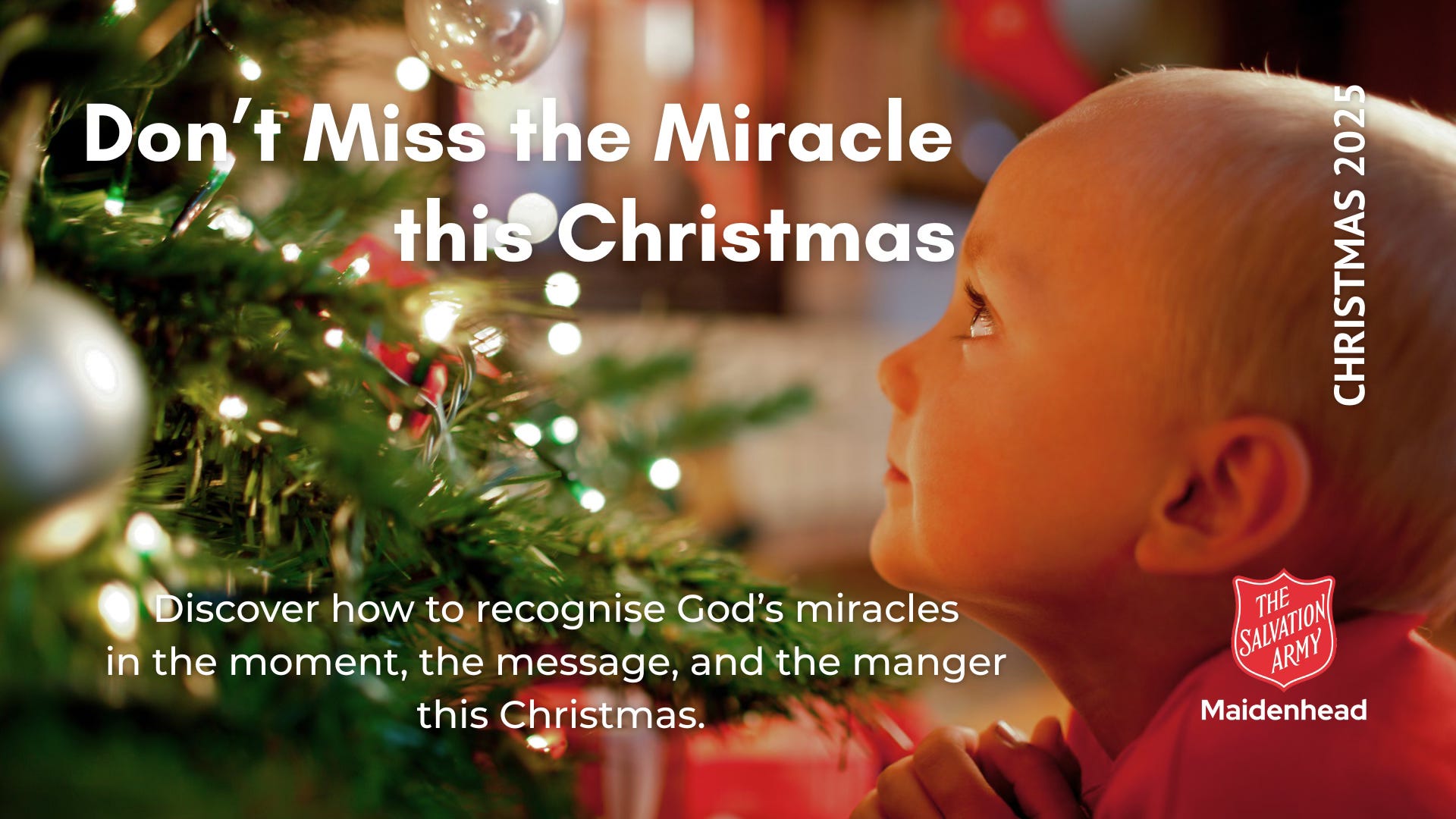
This seven-day Battle Drill series helps you move from second-hand religion to present-tense trust in Jesus. Grounded in Jacob’s Bethel encounter (Genesis 28) and Peter’s vision of believers as “living stones” and a “royal priesthood” built on Christ the Cornerstone (1 Peter 2), each 5-minute devotional pairs Scripture with real frontline moments - from the hall and high street to the classroom, workplace, and home. Expect simple, practical steps: a twelve-word morning prayer, renaming hard spaces as “Bethel,” asking movement-making questions in meetings, and practising a one-minute priesthood of care. Ideal for Christians seeking daily encouragement and simple Bible application - and for friends exploring faith - this series nurtures spiritual resilience, everyday witness, and hope in ordinary places. Use it for personal rhythms, small groups, or a YouTube playlist to reach seekers with clear, compassionate Salvation Army ministry. 
Here are the Battle Drill Daily Devotionals for the coming week. The accompanying video and audio podcast episodes will be published each day.
Thanks for reading Battle Drill Devotional! Subscribe for free to receive new posts and support my work.
Are You Too Busy for A Miracle This Christmas?
Sunday 30 November 2025
Have you ever noticed how the Christmas season can feel less like a silent night and more like a frantic race to the finish? We’re running around, ticking off lists, trying to craft that perfect Christmas. It’s exhausting, isn’t it? What if the very busyness of celebrating Christmas is stopping us from truly experiencing it?
The Bible says Jesus arrived at the exact right moment, but into a world too busy to notice. It makes me wonder: are we making the same mistake? A line in Galatians chapter 4 always stops me: “But when the set time had fully come, God sent his Son”. This tells us all of history was a countdown to this perfectly planned moment. It wasn’t a Plan B. It was God’s divine appointment.
Yet this miracle arrived in an overwhelmed world. First-century Judea was a place of constant tension under Roman occupation. Then, Caesar ordered a census - a massive disruption, forcing people like Mary and Joseph to drop everything and travel for days. The world wasn’t waiting with open arms for Jesus. It was stressed, busy, and just trying to get by.
So, when they get to Bethlehem, they’re met with those words: “no room”. There was no room in the inn, probably a crowded guest space. But on a deeper level, there was no room in a world wrapped up in its own agenda. The King of all creation arrived not with a grand announcement, but in the quiet of a stable. The experts and rulers missed it. The miracle happened on the margins.
So, who got the announcement? A group of shepherds - social outcasts. Why them? Perhaps because out in the stillness of the fields, away from the chaos, they were the only ones paying attention. They were awake, watching, and available for their night to be interrupted by something sacred.
This brings the story to our front door. Are we any different? Today’s distractions just look different. Our “imperial census” might be a gift list that feels a mile long, or a calendar so packed we can’t breathe. Our anxiety might be the pressure to keep up and post that perfect family photo. Without meaning to, our hearts and our schedules become a modern-day inn with a “No Room” sign on the door. We get so busy preparing for Christmas that we leave no space to experience Christ.
But it doesn’t have to be this way. The invitation this season is to intentionally make room. You don’t have to miss your miracle. So, here’s the challenge: What is one thing this week you can say ‘no’ to, so you can say ‘yes to making room for Jesus? Maybe it’s skipping one event for a quiet night at home or putting your phone down for 30 minutes to just be still and pray. Let me know in the comments what you’re setting aside. Your story might help someone else do the same.
Let’s pray.
Father, thank you for sending Jesus at just the right time. Forgive us for getting so busy that we leave no room for you. Help us clear a little space in our schedules and hearts this week. Open our eyes to see the miracles you want to do in our lives. Amen.
The message of Christmas is a promise. God broke into a busy world then, and he wants to break into our busy lives now. A miracle is waiting, but it won’t shout over the noise. It waits for you to pause, to look, and to listen. Don’t be too busy for your miracle.
The Silence Before the Miracle
Monday 1 December 2025
Have you ever felt like God has gone quiet on you? Like you’re praying and waiting, but only getting silence back? We often jump straight to the joy of the Christmas story, but what if it really begins in a profound, centuries-long silence? For four hundred years, no new prophetic word was recorded for God’s people. An entire nation was left waiting, wondering if God had forgotten them.
This period, often called the “400 Years of Silence”, is the backdrop for the New Testament. It’s no coincidence that the Christmas story itself kicks off not with a shout, but with an imposed silence.
Consider the priest Zechariah. An angel brought unbelievable news: he and his elderly wife, Elizabeth, would have a son. In shock, Zechariah questioned this, so the angel Gabriel made him silent until the promise was fulfilled. This wasn’t just a punishment. It was a sign. Zechariah’s personal silence mirrored the centuries of quiet the entire nation had endured. In that sacred pause, he could only wait and watch God’s plan unfold. It proved the silence wasn’t empty, but full of anticipation. While Israel waited, God was quietly setting the stage for the “fullness of time” when the Word himself would arrive.
“Silent” is the last word any of us would use for our lives, right? The noise from notifications, deadlines, and Christmas chaos is constant. But Advent invites us into the same silence given to Zechariah. Consider Psalm 46:10: “Be still and know that I am God”. The Hebrew word for “be still”, raphah, doesn’t just mean to be quiet. It means to let go, to relax your grip, and to release your striving. It’s a command to stop trying to control everything and just surrender to him. This is an intentional spiritual discipline. Being still isn’t about doing nothing. It’s a powerful act of faith. It’s the posture that creates space for the miraculous. When we finally stop talking and planning, we create room to truly hear God’s voice.
But how do we practically do this, especially now? First, schedule it. Find ten minutes in the morning, on a lunch break, or even in your car. Put it on your calendar. Second, simplify. Review your to-do list and ask God what’s truly necessary. Saying “no” to even one thing can create incredible space for stillness. Third, create a quiet space. It can be as simple as dimming the lights and lighting a candle. Use that space to just breathe. Try a simple breath prayer, like inhaling to “Lord, have mercy”, and exhaling to “Christ, have mercy”.
I challenge you to try finding God in the quiet this week. Come back and let me know in the comments: what is one way you are choosing to cultivate silence this Advent? And if devotionals like this, helping you connect with God in your everyday life, are helpful for you, make sure you subscribe.
The four-hundred-year silence was shattered not by thunder, but by a baby’s cry. Zechariah’s muteness ended with praise the moment he named his son, John. In both stories, a long, expectant quiet preceded a miracle that changed everything. Silence wasn’t God’s absence, but his preparation. The same is true for us. Your moments of stillness aren’t empty. They are sacred spaces where God is at work. When you quiet your life, you make room in the manger of your heart for the miracle to be born again. Embrace the silence. It might just be the space before your miracle.
The Strategy Behind the Stable
Tuesday 2 December 2025
Have you ever felt like you’re in a place that just doesn’t matter? A season, a job, or even a town that feels completely overlooked, totally insignificant. It’s exhausting trying to make something out of what feels like nothing. But what if those overlooked moments aren’t a mistake? What if they’re actually the centrepiece of God’s strategy for your life?
For centuries, an ancient prophecy promised a Savior would come from a tiny, almost forgotten town called Bethlehem. Today, we’re looking at the strategy behind that humble stable because it shows how God uses the insignificant to do the impossible. We know the story: a young couple, a hard journey, and “no room in the inn”. They find refuge in a space for animals, with a feeding trough for a crib. No strategist would choose a stable for the arrival of a king, yet that’s exactly what God did. The choice of Bethlehem wasn’t an accident or a backup plan. It was a deliberate, divine masterstroke centuries in the making. That stable wasn’t a setback. It was the stage.
Over 700 years before that night, the prophet Micah delivered a stunningly specific message from God:“But you, O Bethlehem Ephrathah, are only a small village among all the people of Judah. Yet a ruler of Israel...will come from you on my behalf”. God didn’t point to the power of Jerusalem or Rome. He pointed to Bethlehem, a town so overlooked it was sometimes left off official lists. He announced his strategy centuries in advance, even using a decree from Caesar Augustus to move Mary and Joseph into the exact right place at the exact right time. God didn’t just know it would happen in Bethlehem; He chose it. The question is, why?
First, it was about the Lineage of a King. Bethlehem was the City of David, the hometown of Israel’s greatest king. God had promised David one of his descendants would sit on the throne forever. For Jesus to be the prophesied Messiah - the “Son of David” - his birth in David’s city was essential. It stamped his lineage with royal authority.
Second, it was about the House of Bread. The name Bethlehem literally means “House of Bread”. This isn’t a minor detail. It’s the cornerstone of the strategy. In the “House of Bread”, the one who would declare, “I am the bread of life”, was born. And he was placed in a manger - a feeding trough. From his first breath, God was showing us that he is the provision for our deepest hunger.
This is where God’s ancient strategy becomes intensely personal. The pattern in Bethlehem is the one he uses in our lives, delighting in using the small and overlooked to do his greatest work. Maybe you’re in a “Bethlehem moment” right now, feeling small or forgotten. I’ve been there, facing a sudden job loss and feeling my identity crumble. You look at your circumstances, and they feel more like a humble stable than a palace. You see limitation, not potential.
But the strategy of the stable declares that God chose Bethlehem because it was small. He chose the stable to prove his power isn’t tied to worldly status. Your humble circumstances don’t disqualify you. They qualify you for his grace. Your weakness is where his strength shows up. The parts of your story that feel insignificant are where he is writing his masterpiece.
The strategy is clear: God uses the humble to display his glory and the small to change the world. The prophecy, the lineage, the Bread of Life - it all reveals an intentional God who chose an overlooked town to show us that no person is ever overlooked by him.
So, what is your “Bethlehem moment” right now? If you feel comfortable, share in the comments how this encourages you to see God’s strategy at work.
For The Person Who Needs a Miracle This Christmas
Wednesday 3 December 2025
Have you ever noticed how, right in the middle of all the Christmas cheer, you can feel completely alone? The world sings about peace and joy, but your heart is heavy, carrying a prayer you’ve held for a very long time. It’s exhausting watching others get their answered prayers while you feel stuck and forgotten by God.
If that’s you, what if this spiritual drought isn’t a sign of God’s absence? What if it’s the sign that he’s preparing to do something new? An ancient promise in Deuteronomy about rain reveals how God plans to show up at just the right time, with exactly what we need.
In Deuteronomy chapter 11, God promises the people entering the Promised Land, “…I will send rain on your land in its proper season, the autumn and spring rains, so you will be able to harvest your crops”. For us, rain is just a forecast, but for a desert people, it was the difference between life and death. They couldn’t control it. All they could do was wait and trust God. The first rains, or autumn rains, softened the hard ground for planting, and the later, spring rains brought the harvest. Both had to arrive at the perfect time.
This was God’s way of showing them, “I am your source. I know what you need, and I know when you need it”. The rain was a tangible sign of his faithfulness. And isn’t that the very nature of a miracle? A divine provision that shows up at the perfect moment. This pattern of waiting followed by provision finds its ultimate expression in the Christmas story itself. For centuries, Israel waited for a Messiah as their world grew dark. That hope must have felt so distant - maybe like yours feels today.
And then, at just the right time, God sent the rain. But it didn’t look like a storm. It looked like a teenage girl, a humble carpenter, and an impossible situation. The world was waiting for a conquering king, but God sent a baby in a feeding trough to save their souls. His timing was perfect. The birth of Jesus was the ultimate “rain” the whole world was waiting for. He was, and is, the miracle.
So, what does this mean for you, this Christmas, as you’re waiting for your own miracle? It means this season of waiting isn’t punishment. It’s preparation. It’s your own personal Advent. Just like the ground must be ready for the rain, maybe God is preparing our hearts for the miracle he has in store. Your drought is not a sign you’ve been forgotten. It’s the necessary season before the harvest. God’s timing isn’t our timing, but it is always perfect. The Christmas story is our guarantee that God sees you, he knows what you need, and he is faithful. Your rain is coming.
Let’s pray. Father, for the person whose heart is aching, I ask for your peace. Strengthen them in this season of waiting and remind them of your faithfulness, shown perfectly in the gift of your Son. Help us trust that you see us, you hear our prayer, and you will send the rain in its proper season. Amen.
If you are believing for a miracle with me this Christmas, declare it in the comments. Just write, “My miracle is on its way”. If this helped you today, please share it. You never know who in your life needs to be reminded that their rain is coming.
When You Are Utterly Helpless God Does THIS
Thursday 4 December 2025
Have you ever felt completely stuck, without the words to pray? You’ve tried everything, exhausted all options, and you’re at the end of your rope. If that’s you, I want you to hear this: you might be in the perfect position for a miracle. The Bible shows us that when we are at our weakest and most helpless - that is precisely when God chooses to step in.
This isn’t just a nice thought. It’s a divine promise from Romans 5:6: “When we were utterly helpless, Christ came at just the right time and died for us sinners”. Let that sink in. Utterly helpless. At just the right time. This reveals something profound about God. His help isn’t triggered when we have it all together. His power is perfected and displayed in our weakness.
Christ’s arrival on earth wasn’t random. It was divinely orchestrated for the moment humanity was powerless to save itself. That same principle applies to your life. This feeling of helplessness is not a sign of God’s absence. It’s often the announcement that his perfect timing is about to be revealed. The verse also says he did this for “sinners”. This is crucial. God’s help isn’t a reward for being worthy. It’s a gift of pure grace, given when we can’t earn it.
Imagine falling into deep water. You flail and fight to stay afloat. A rescuer on the shore is ready to help, but they have to wait. If they jump in while you’re panicking, you might pull them down with you. They must wait for the moment of exhaustion when you stop struggling. In that surrender, they can safely pull you out. How many of us are spiritually flailing, trying to fix our own situations, and exhausting ourselves? Your helplessness might be God’s invitation to stop fighting, let go, and allow him to be your rescuer.
So, can you reframe this feeling of powerlessness? Instead of your breaking point, see it as your breakthrough point. This requires a shift from, “I am helpless”, to a faith-filled, “Now I can receive God’s help”. From “I am stuck”, to “This must be the right time for God to move”. Think about a time you felt helpless, but then God’s peace or provision arrived. That wasn’t coincidence. That was Romans 5:6 playing out in your story.
If you believe God’s timing is perfect and he will step into your helplessness, declare that by faith. Type “AMEN” in the comments. Let it be an act of surrender, a signal to your heart and to heaven that you are ready to stop struggling and let God take over.
Let me pray for you. Father, I lift up the person listening to or reading this. You see their struggle and their helplessness. They are at the end of their own strength, which, according to your Word in Isaiah 41:10, is the beginning of yours. Help them to let go, to surrender the fight, and to fall into your arms. Thank you that your love isn’t based on our performance. Intervene at just the right time, Lord. We trust you. Amen.
May you feel the peace of God, and be filled with hope, knowing your Help is already with you. Your greatest need is the perfect stage for God’s greatest glory. God bless you.
Now Is the Right Time
Friday 5 December 2025
We all have that one conversation we’re putting off, don’t we? That person we know we should forgive, but we can’t find the words. We tell ourselves we’re just waiting for the right moment when it won’t feel so awkward. But waiting for the ‘right time’ is often an excuse to avoid the hard work of healing. It’s exhausting, carrying that weight of unforgiveness. What if this Advent is God’s interruption to our endless waiting?
We think we’re being patient, but often, we’re just procrastinating. We’re afraid of conflict and uncertain of the outcome, so we put it off. We wait. But the season of Advent is all about an arrival. It is a divine announcement that the waiting is finally over.
Our lives are often ruled by Chronos - sequential time, the time of delay that lets us say, “I’ll deal with it tomorrow”. But the Bible has another word for time: Kairos. This isn’t about minutes. It’s about the significance of the moment - God’s appointed time, a divine window of opportunity. Jesus began his ministry announcing the Kairos had come. This is the heart of Advent. It is a season of Kairos, God breaking into our schedules to say the time for healing is now. As Paul writes in 2 Corinthians, “Behold, now is the accepted time”. The right time isn’t coming. It’s here.
Consider Joseph in Genesis. Sold into slavery by his brothers, he spent years in prison. He had every reason for bitterness, ample Chronos time to plot revenge. But when his brothers appeared before him, starving, Joseph faced a choice: stay on his timeline of hurt, or step into God’s Kairos moment? He saw God’s bigger plan, telling them, “You intended to harm me, but God intended it for good”. He chose forgiveness on the spot. Joseph recognised the divine moment for grace and seized it, starting a new chapter for his family.
What does this mean for us this Advent? Firstly, Advent is about making room in our hearts. We can’t welcome Christ’s joy if our hearts are cluttered with old wounds. Forgiveness is a spiritual decluttering, making space for the Prince of Peace. Secondly, forgiveness is a gift you give yourself. Unforgiveness is a prison that chains you to the past. Forgiving gives yourself the gift of freedom. Finally, Christ’s birth is the ultimate example. God didn’t wait for us to be perfect. He sent Jesus into our mess. In the same way, we must bring forgiveness into our imperfect relationships now, not waiting for a moment that will never arrive.
Let’s stop waiting for the ‘right time’. The waiting is over. This Advent is the Kairos moment God offers you. That difficult conversation, that decision to let go - today is the day.
Let’s pray.
Lord, thank you for breaking into our timelines. Grant me the courage to step into your Kairos time, the strength for the conversation I’ve been avoiding, and the grace to forgive. Not because they earned it, but because you have called me to be free. Help me make room for your peace this Advent. Amen.
The God who came as a child gives you today’s strength. May this season give you the courage to embrace God’s perfect timing.
Recognising the Miracle of the Moment
Saturday 6 December 2025
Have you noticed how the pressure builds at this time of year? The calendar gets full, the to-do list grows, and we end up chasing a ‘perfect’ Christmas. It’s exhausting. We focus so much on preparing for a grand finale that we risk missing the point of it all.
But what if your worth, and the miracle of this season, isn’t something you have to create, but something you’ve already been given? What if the miracle is found not in a perfect, planned moment, but in an interruption we never saw coming?
For a group of ordinary shepherds on a quiet hillside two thousand years ago, an interruption changed everything. Through them, God shows us how to find the miracle right in the middle of our own ordinary moments.
It’s easy to get caught up, isn’t it? Scrolling online for that perfect recipe or decoration, trying to manufacture a feeling. We can get so busy doing that we risk missing the very miracle we’re meant to be celebrating. We think God shows up in big, glorious events, but the Christmas story starts so much quieter. It begins in the ordinary, with ordinary people, just like you and me.
Have you ever found yourself waiting for the ‘right time’ to feel at peace? Waiting until the house is clean to finally connect with God? It’s like living in anticipation of what could be, rather than having gratitude for what is. The story of the shepherds teaches us that God doesn’t wait for us to create a spectacle. He breaks into our reality, just as it is.
Let’s picture these men. They weren’t heroes or religious leaders. Their job was looked down on. In their society, shepherds were often seen as unreliable people on the margins, whose testimony wasn’t even allowed in a court of law. Their lives were repetitive, spent out in the fields, far from the centres of power.
On this particular night, they were just doing their job - watching the sheep. It was an ordinary night, a routine they had done hundreds of times before. They weren’t in the temple or in a special posture of prayer. They were simply present, doing their work. And isn’t it amazing that that’s exactly where God chose to send the most important birth announcement in history?
And then it happens. Suddenly, an angel appears, and the Bible says the glory of the Lord shone around them. They were terrified. The angel’s first words are, “Don’t be afraid! I bring you good news that will bring great joy to all people”. The news is for everyone, but he delivers it first to these men. And the sign they were given wasn’t a king on a throne, but a baby, wrapped in cloths and lying in a manger - a sign as humble as they were.
But here’s the most crucial part: their response. The moment the angels leave, they don’t hesitate or second-guess the experience. They turn to each other and say, “Let’s go to Bethlehem! Let’s see this thing that has happened, which the Lord has told us about”. Their response was immediate. They heard the message, and they moved.
That immediate, faith-filled response is the real lesson for us. How often do you feel that quiet nudge from God in your own life - a prompting to reach out, to change course, or just to be still? And what do we do? Often, we hesitate. We tell ourselves it’s not the right time, or we dismiss it as insignificant. The shepherds could have easily decided their flock was too important to leave. But they didn’t. They recognised the miracle in that moment and they acted.
This Advent, God is still breaking into the ordinary fields of our lives. He shows up in a quiet moment of peace amidst the chaos, or an unexpected conversation. These are our own angelic interruptions. The question is, will we recognise them? And how will we respond?
When the shepherds returned to their fields, their circumstances hadn’t changed, but they had. They went back “glorifying and praising God for all the things they had heard and seen”. Their encounter with the miracle transformed their perspective. Their identity was no longer just ‘shepherd’. They were now the first evangelists, sharing the good news. It reminds us that our worth isn’t found in what we do, but in who God says we are.
Like the shepherds, we are invited to see God’s work in our present moment and respond with wonder. Here is the invitation for this coming week: Let’s pray to have the eyes of the shepherds, looking for God not just in grand carol concerts and services, but in the unexpected interruptions of our daily lives.
Lord, thank you for the example of the shepherds. It’s so easy to get swept up in the rush of this season. Please, help us to slow down enough to recognise your presence in the ordinary moments. Give us a faith like theirs, one that doesn’t hesitate to respond when you call. Fill our hearts with that same wonder and joy that sent them praising you all the way back to their fields. Amen.
For more devotionals and resources, visit battledrilldevotional.com. Prefer watching? Check out our video devotionals at video.battledrilldevotional.com. Sign up via email at devotional.battledrilldevotional.com. See our Sermons at battlereadysermons.com. Sign up via email at sermons.battlereadysermons.com.
Unless otherwise shown, all Scripture quotations are taken from the Holy Bible, New Living Translation, copyright 1996, 2004, 2007, 2015 by Tyndale House Foundation. Used by permission of Tyndale House Publishers, Inc., Carol Stream, Illinois 60188. All rights reserved. All song extracts used by permission. CCL Licence No. 135015.